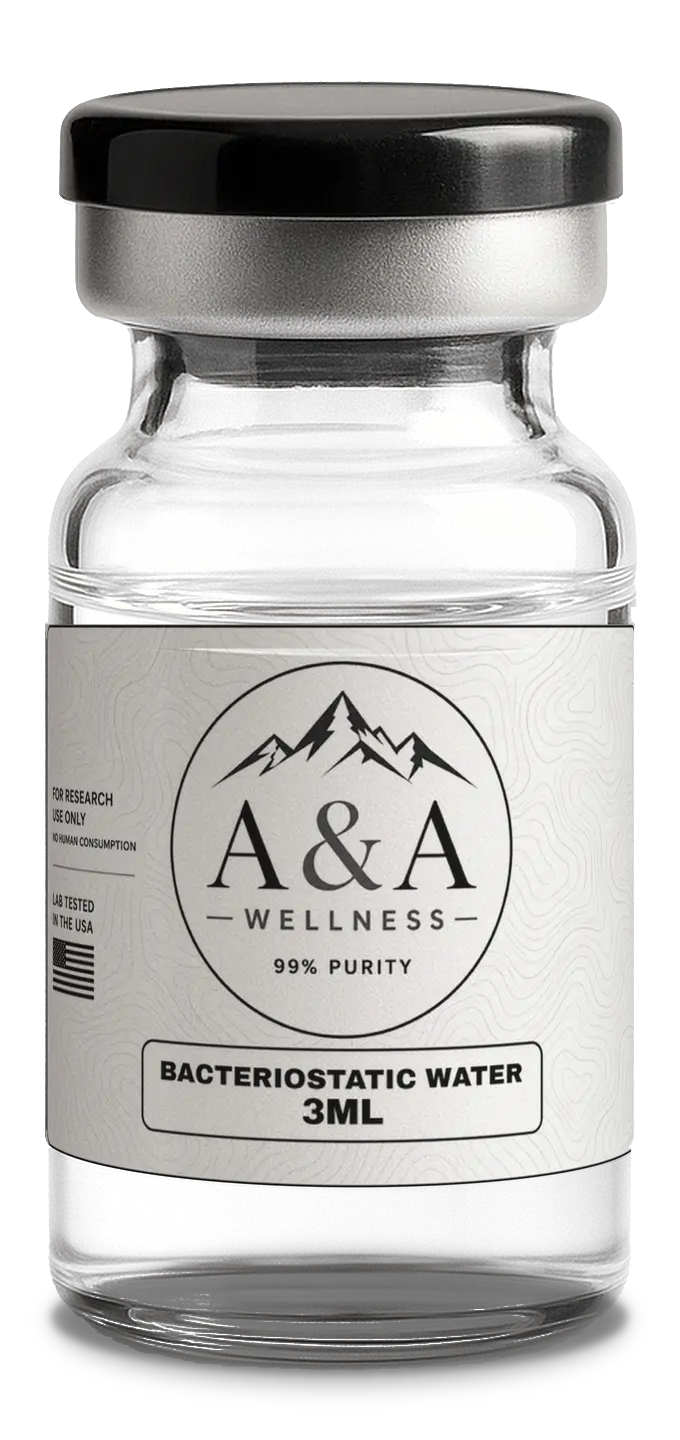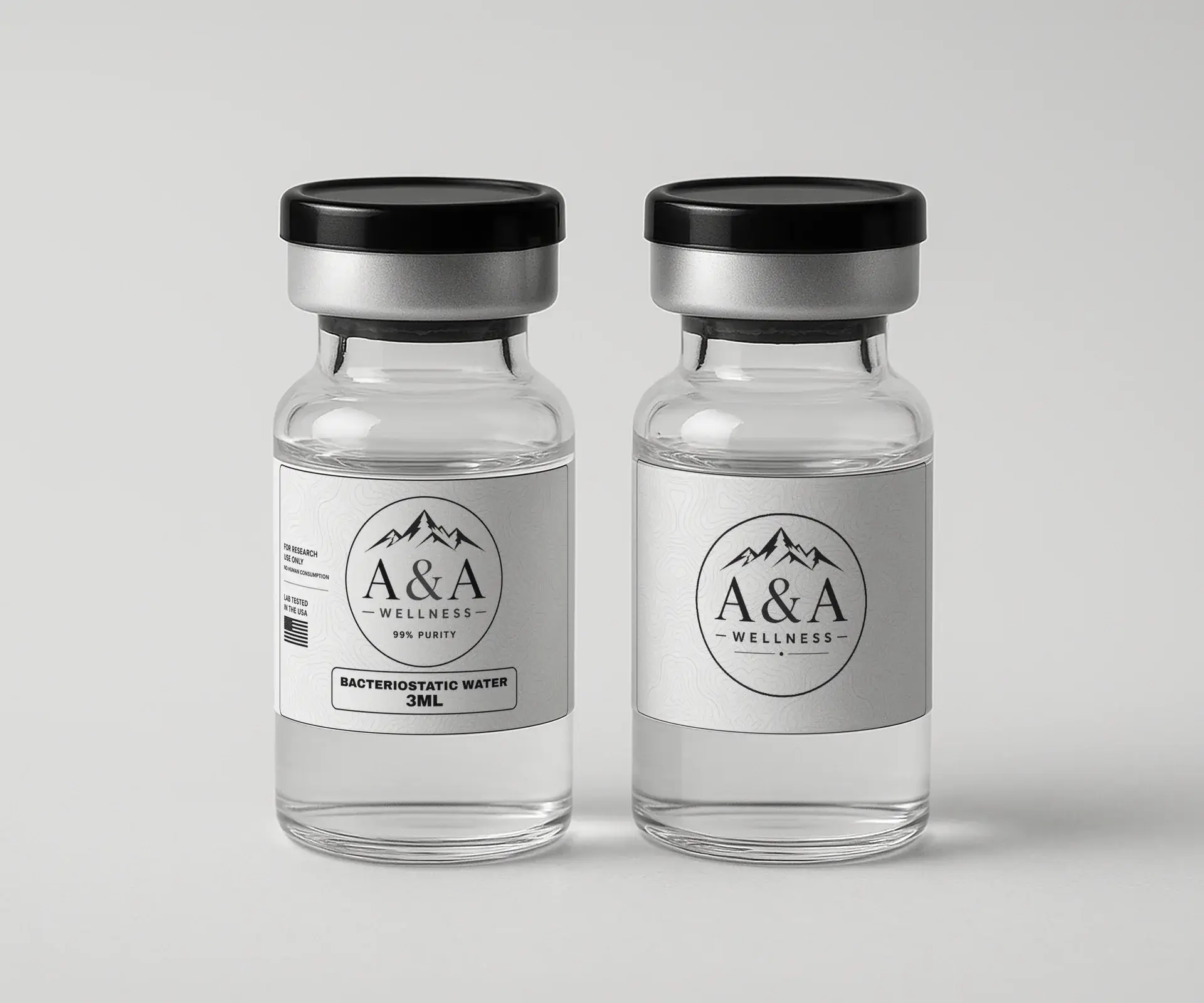
Two clear liquids, two very similar names, and one important difference. Bacteriostatic water and sterile water are both used in laboratories to dissolve lyophilized materials, but they are not interchangeable. This guide explains what each contains, how their containers are meant to be used, and how to choose between them for a peptide workflow.
The Short Answer
| Bacteriostatic water | Sterile water | |
|---|---|---|
| Base | Sterile water | Sterile water |
| Preservative | Benzyl alcohol, commonly 0.9% (9 mg/mL) | None |
| Added buffer or antimicrobial | Benzyl alcohol only | None |
| Container type (per Pfizer labeling) | Multiple-dose | Single-dose only |
| Best suited to | Preparations entered more than once | Single-use preparations; preservative-sensitive work |
What Is Sterile Water?
Sterile water is purified water with nothing added. Pfizer’s labeling for Sterile Water for Injection, USP, describes it as a sterile, nonpyrogenic preparation that contains no bacteriostat, antimicrobial agent, or added buffer. It is supplied only in single-dose containers.
Single-dose means one entry. Because there is no preservative, anything introduced when the container is opened has nothing to inhibit its growth. Standard practice for single-dose containers is to use the contents for one preparation and discard the remainder.
Why labs choose it:
- No additional chemical in the final solution
- Suited to assays where a preservative could be a variable
- Appropriate when the entire preparation will be used in one session
What Is Bacteriostatic Water?
Bacteriostatic water is sterile water plus a preservative. Pfizer’s labeling for Bacteriostatic Water for Injection, USP, describes a sterile, nonpyrogenic preparation containing benzyl alcohol as a bacteriostatic preservative. The labeling lists 0.9% (9 mg/mL), and for some presentations 1.1% (11 mg/mL). The stated pH is 5.7, within a range of 4.5 to 7.0.
Multiple-dose means repeated withdrawals. According to the same labeling, it is supplied in a multiple-dose container from which repeated withdrawals may be made to dilute or dissolve other materials.
What “bacteriostatic” actually means
It inhibits growth; it does not sterilize. A bacteriostatic agent slows or stops bacterial multiplication. It does not kill all organisms, and it cannot rescue a container that has been contaminated through poor technique. Every entry into the vial still calls for a disinfected stopper and a sterile transfer device.
It protects the diluent, not the peptide’s chemistry. Benzyl alcohol limits microbial growth. It does not slow the chemical degradation of a dissolved peptide, such as oxidation or deamidation. Peptide solutions still need cold storage and short working windows. See our peptide storage guide.
Bacteriostatic Water vs Bacteriostatic Saline
These are easy to confuse. Bacteriostatic sodium chloride contains 0.9% sodium chloride in addition to the benzyl alcohol preservative. Bacteriostatic water contains no salt. The ionic strength of your final solution will differ depending on which you use, which can matter for solubility and for some assays. Confirm which diluent your protocol specifies.
Published Safety Notes on Benzyl Alcohol
Benzyl alcohol has well-documented labeling warnings in clinical contexts, and it is worth being aware of them when handling any benzyl-alcohol-containing diluent.
- Neonatal warning on labeling. Pfizer’s labeling for Bacteriostatic Water for Injection, USP, carries the statement “NOT FOR USE IN NEONATES” because of the potential toxicity of benzyl alcohol in that population.
- Historical basis. A 1982 report in the CDC’s Morbidity and Mortality Weekly Report described neonatal deaths associated with benzyl alcohol used as a preservative in intravascular flush solutions. The report noted that similar deaths had not occurred after preservative-free solutions were substituted.
- European labeling. The UK Summary of Product Characteristics for Bacteriostatic Water for Injection describes benzyl alcohol toxicity in neonates, sometimes referred to as “gasping syndrome.”
These warnings apply to clinical products and settings. A&A Wellness supplies bacteriostatic water as a laboratory research supply. It is for research use only and is not for human or veterinary use. Handle it as you would any laboratory reagent, following your institution’s chemical safety procedures.
Choosing a Diluent for Peptide Work
When bacteriostatic water fits
- A stock vial will be accessed more than once. The preservative helps limit microbial growth between entries.
- Your assay tolerates benzyl alcohol. Confirm this before relying on it.
- The peptide dissolves readily in water. Bacteriostatic water is not a solubility aid.
When sterile water fits
- The entire preparation will be used at once, or immediately aliquoted and frozen.
- A preservative would be an unwanted variable in your experiment.
- Your protocol specifies an unpreserved diluent.
When neither is the right choice
Some sequences need a different solvent. Bachem’s handling guidelines note that basic peptides often dissolve better in slightly acidic conditions, acidic peptides in slightly basic conditions, and hydrophobic peptides may require a small amount of organic solvent before dilution. In those cases, a dilute acid, buffer, or other solvent may be more appropriate. Check the compound’s education page and any supplier guidance.
Handling Tips for Both Diluents
- Store per the diluent’s label. Pfizer’s labeling for Bacteriostatic Water for Injection, USP, specifies 20 to 25 °C (68 to 77 °F).
- Record the first-opened date. Write it on the container of any multiple-dose diluent.
- Disinfect the stopper every time. Use a 70% alcohol wipe and let it dry.
- Never return unused diluent to its container.
- Discard if in doubt. Cloudiness, particles, or a compromised seal are reasons to replace the diluent.
- Keep diluents and peptides clearly labeled. Two clear liquids look identical once in a vial.
Documenting Diluent Use
Record the diluent as carefully as the peptide. When results are reviewed later, the diluent is one of the first variables people ask about. For every preparation, note:
- Diluent type, such as sterile water, bacteriostatic water, or a named buffer
- Preservative and concentration, where applicable (for example, 0.9% benzyl alcohol)
- Diluent lot number and container size
- Date the diluent container was first opened
- Volume used, so the final concentration can be recalculated
Keep one diluent per stock series. Switching between preserved and unpreserved diluents partway through a study introduces a variable that is easy to overlook and hard to untangle afterward.
For the full dissolution procedure, including adding diluent down the vial wall and concentration math, see Reconstituting Peptides for Laboratory Use.
Key Takeaways
- Sterile water has nothing added and is intended for single use.
- Bacteriostatic water contains benzyl alcohol (commonly 0.9%), which inhibits bacterial growth and allows multiple withdrawals.
- “Bacteriostatic” inhibits growth; it does not sterilize or stabilize peptide chemistry.
- Benzyl alcohol carries published neonatal warnings on clinical labeling; A&A’s supply is for laboratory research only.
Find Bacteriostatic Water in 3 mL and 10 mL sizes in our Research Supplies category, or review our quality standards.
Sources
- Pfizer Labeling. Bacteriostatic Water for Injection, USP
- Pfizer Labeling. Sterile Water for Injection, USP
- CDC. Neonatal Deaths Associated With Use Of Benzyl Alcohol — United States. MMWR. 1982
- electronic medicines compendium (emc). Bacteriostatic Water for Injection — Summary of Product Characteristics
- Bachem. Handling and Storage Guidelines for Peptides