Reconstitution is the step where a stable, dry peptide becomes a working solution, and where most handling errors happen. A rushed addition of diluent, a vigorous shake, or an unlabeled vial can compromise material or make results impossible to trace. This guide covers general aseptic laboratory technique and the arithmetic behind concentration and dilution.
Scope note. This is a general laboratory handling guide for research-use-only materials. It does not provide, and should not be read as, guidance for human or animal use. Always follow your institution’s SOPs and any compound-specific instructions on the product label.
Before You Start
Gather materials
- The lyophilized peptide vial, equilibrated to room temperature (see below)
- A suitable diluent, such as sterile water, bacteriostatic water, or an assay-compatible buffer
- Sterile, single-use transfer devices appropriate to your lab, such as calibrated pipettes or a septum transfer set
- 70% isopropyl or ethanol wipes for vial stoppers
- Gloves, and a clean workspace such as a laminar flow hood or biosafety cabinet where your SOP requires one
- Labels and a lab notebook or electronic log
Equilibrate the vial
Let the cold vial reach room temperature before opening. Both Bachem and Sigma-Aldrich recommend this, because moisture from the air will otherwise condense on cold, hygroscopic powder. Bachem suggests equilibrating in a desiccator.
Check the documentation
Confirm the compound name, lot number, and stated mass on the vial. If a certificate of analysis is available for the lot, note the reported net peptide content if given. It affects your concentration calculation. Our COA guide shows where to find it.
Choosing a Diluent
The right diluent depends on the peptide and the experiment. Bachem’s guidance notes that basic peptides tend to dissolve better in slightly acidic conditions, acidic peptides in slightly basic conditions, and very hydrophobic peptides may need a small amount of organic solvent before dilution. Sigma-Aldrich suggests sterile distilled water or sterile 0.1% acetic acid for many working stocks.
Common laboratory options
- Sterile water. Contains no preservative, antimicrobial agent, or added buffer, per Pfizer’s labeling for Sterile Water for Injection, USP. Suited to single-use preparations or where a preservative could interfere with an assay.
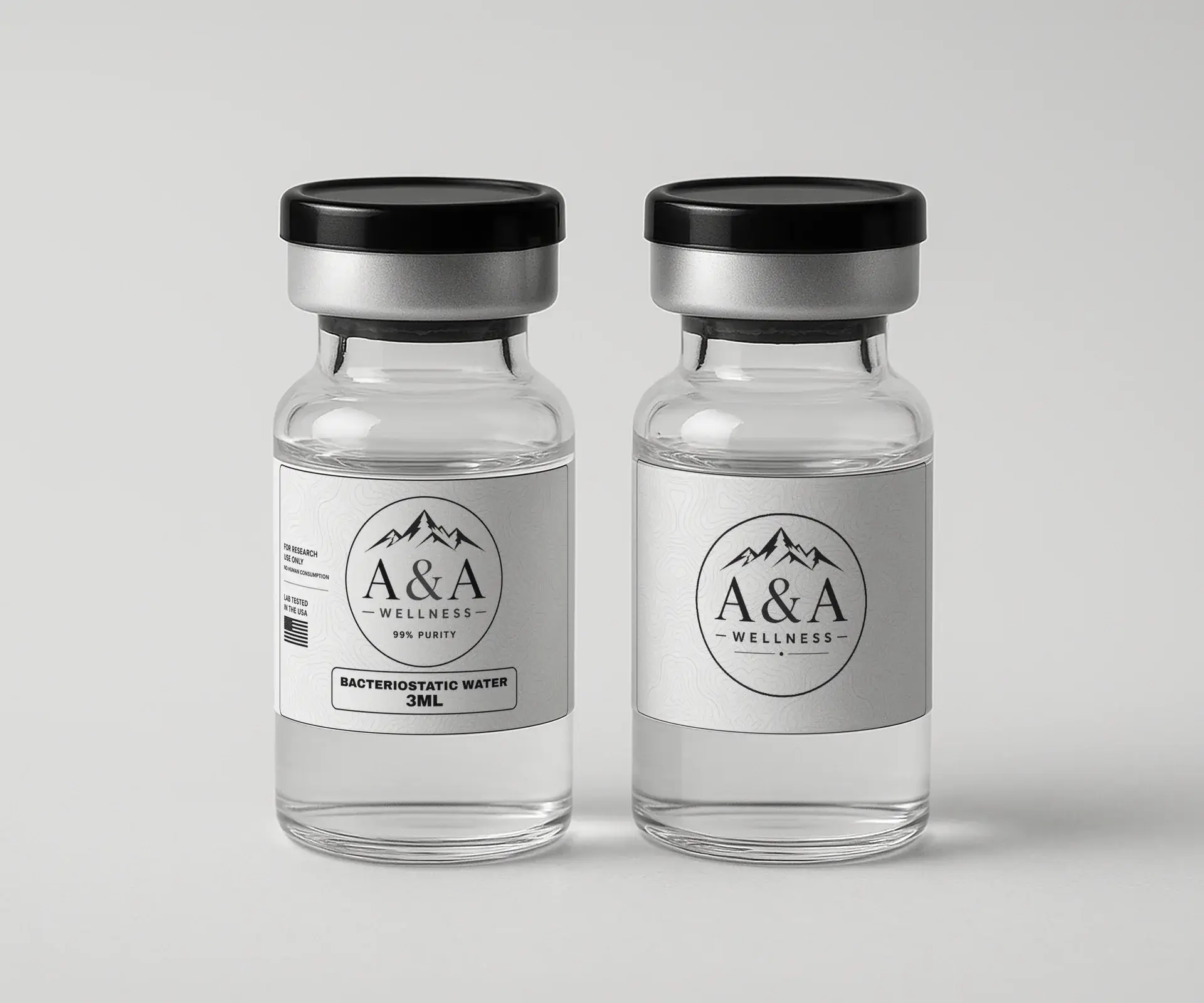
- Bacteriostatic water. Water containing 0.9% (9 mg/mL) benzyl alcohol as a preservative, supplied in a multiple-dose container according to Pfizer’s labeling. Suited to workflows where a vial will be entered more than once.
- Dilute acid or buffer. Chosen for solubility or pH compatibility with a specific sequence or assay.
Check assay compatibility. A preservative is an additional chemical in your solution, so confirm it is appropriate for your assay before choosing a preserved diluent. Our bacteriostatic vs sterile water guide covers the trade-offs in detail.
Step-by-Step Aseptic Technique
1. Prepare the workspace
Clean the work surface, put on gloves, and arrange materials so you can work without reaching over open containers. Work in a hood or cabinet if your SOP requires it.
2. Disinfect the stoppers
Remove the protective flip cap from the peptide vial and the diluent container. Wipe each rubber stopper with a 70% alcohol wipe and let it air-dry. Do not touch the stopper after wiping.
3. Measure the diluent
Using a sterile transfer device, draw the planned volume of diluent. Accuracy here determines the accuracy of your final concentration, so use a device calibrated for the volume involved.
4. Add diluent slowly down the vial wall
Direct the diluent onto the inside glass wall, not onto the powder. Tilt the vial slightly and let the liquid run down the side. A forceful stream aimed directly at the cake can cause foaming and scatter material onto the stopper.
Go slowly. Adding the volume over several seconds, rather than all at once, gives the powder time to wet evenly.
5. Swirl, don’t shake
Gently swirl or roll the vial between your fingers. Vigorous shaking introduces air and foam. Air-liquid interfaces are a known stress for peptides and proteins and can promote aggregation.
Give it time. Most peptides dissolve within a few minutes. If material remains, let the vial stand and swirl again. For difficult sequences, consult the manufacturer’s solubility guidance for that sequence rather than forcing the material into solution.
6. Inspect the solution
Hold the vial against light and dark backgrounds. A properly dissolved peptide solution is typically clear. Persistent cloudiness, particles, or gel suggest incomplete dissolution or a solubility problem. Do not use the solution in an experiment until you understand why.
7. Label immediately
Label the vial before it leaves your hands. Include:
- Compound name and lot number
- Concentration (for example, 5 mg/mL)
- Diluent used
- Preparation date and time
- Preparer’s initials
- Storage condition
- “For research use only”
Concentration Math: Worked Examples
All examples below are laboratory calculations for preparing and diluting stock solutions.
Basic concentration
Concentration = mass ÷ volume.
- 10 mg of lyophilized material in 2 mL of diluent: 10 mg ÷ 2 mL = 5 mg/mL
- 20 mg in 4 mL: 20 ÷ 4 = 5 mg/mL
- 10 mg in 5 mL: 10 ÷ 5 = 2 mg/mL
Unit conversions help avoid errors. 1 mg/mL is the same as 1 µg/µL and 1,000 µg/mL. So 5 mg/mL equals 5 µg/µL.
Correcting for net peptide content
Weighed peptide is rarely 100% peptide. As JPT Peptide Technologies explains, peptides are commonly isolated as salts (often trifluoroacetate), and the lyophilized mass includes counterions and some residual moisture. If a lot’s documentation reports net peptide content, adjust the mass first.
- Stated mass: 10 mg. Reported net peptide content: 80%.
- Peptide mass: 10 mg × 0.80 = 8 mg.
- In 2 mL of diluent: 8 ÷ 2 = 4 mg/mL of peptide.
If no net peptide content is reported, record your concentration as based on the stated vial mass so others can interpret it correctly.
Converting to molarity
Molarity = (mass concentration in g/L) ÷ (molecular weight in g/mol).
- A 5 mg/mL solution is 5 g/L.
- For a hypothetical peptide with a molecular weight of 1,000 g/mol: 5 ÷ 1,000 = 0.005 mol/L = 5 mM.
Use the molecular weight from the lot’s documentation or an authoritative reference for the exact sequence and salt form.
Diluting a stock: C1V1 = C2V2
To make a working solution from a stock, use C1 × V1 = C2 × V2.
- Stock (C1): 5 mg/mL. Target (C2): 1 mg/mL. Target volume (V2): 1 mL.
- V1 = (1 mg/mL × 1 mL) ÷ 5 mg/mL = 0.2 mL of stock.
- Add 0.8 mL of diluent for a total of 1 mL.
Blends
For a vial containing more than one compound, calculate each component separately. A hypothetical vial containing 50 mg of compound A and 10 mg of compound B, dissolved in 5 mL, gives 10 mg/mL of A and 2 mg/mL of B. Record both. See our blends such as the Wolverine Blend for stated compositions.
After Reconstitution: Storage
Solutions are far less stable than powder. Bachem advises against long-term storage of peptides in solution and recommends aliquoting and freezing any solution you need to keep. Sigma-Aldrich advises avoiding repeated freeze-thaw cycles.
- Divide the solution into single-use aliquots.
- Freeze aliquots you will not use promptly.
- Thaw one aliquot at a time; do not refreeze leftovers.
- Keep in-use solutions cold and protected from light.
Our peptide storage guide covers these conventions in more depth.
Troubleshooting
| Observation | Possible cause | Next step |
|---|---|---|
| Powder won’t fully dissolve | Solubility depends on sequence and pH | Allow more time; consult manufacturer solubility guidance for the sequence |
| Foam on surface | Diluent added too forcefully or vial shaken | Let stand; add diluent more slowly next time |
| Cloudy solution | Incomplete dissolution or aggregation | Do not use until resolved; contact support with the lot number |
| Material on stopper | Stream hit the cake directly | Aim at the vial wall; swirl gently to rinse |
Key Takeaways
- Equilibrate, disinfect, and add diluent slowly down the vial wall.
- Swirl gently; never shake.
- Concentration equals mass divided by volume: 10 mg in 2 mL gives 5 mg/mL.
- Label every vial immediately and treat solutions as short-term.
Shop diluents in Research Supplies, browse compounds in Research Peptides, and read about our documentation standards on our quality page.