What SS-31 is
SS-31 is a synthetic tetrapeptide, a peptide of just four amino acids. It belongs to the Szeto-Schiller (SS) peptides, named after pharmacologist Hazel Szeto and peptide chemist Peter Schiller, who developed the series. It was later taken into clinical development under the nonproprietary name elamipretide. Earlier literature also refers to it as MTP-131 and Bendavia.
SS-31 is described as mitochondria-targeted: published research reports that it crosses cell membranes and concentrates at the inner mitochondrial membrane, where it associates with the phospholipid cardiolipin.
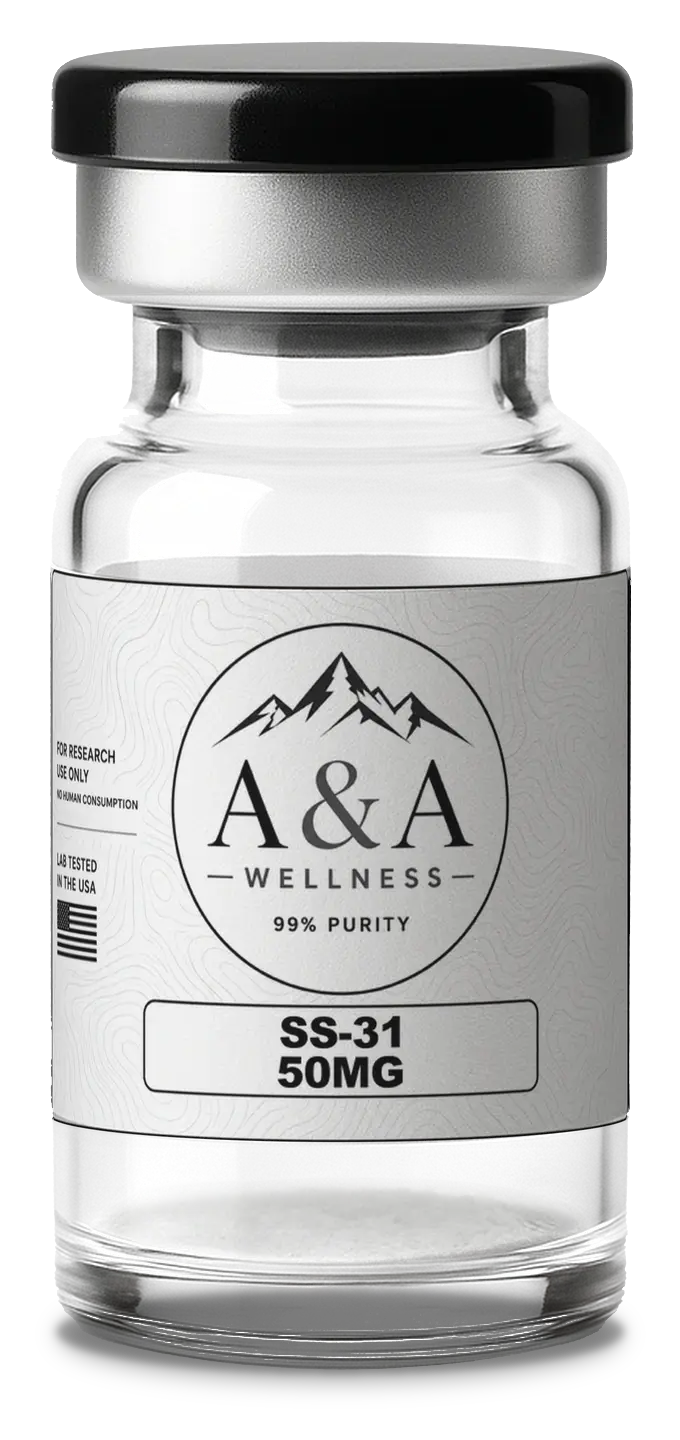
The material A&A Wellness supplies as SS-31 is a research-grade peptide for laboratory use only. It is not the approved pharmaceutical product, not a drug, food, cosmetic or supplement, and not for human or veterinary use.
Classification and structure
An aromatic-cationic tetrapeptide
The SS-31 sequence is D-Arg-Dmt-Lys-Phe-NH2, where Dmt is 2’,6’-dimethyltyrosine. The published design logic centres on an alternating pattern of aromatic and basic residues:
- Basic residues. Arginine and lysine give the molecule a net positive charge at physiological pH.
- Aromatic residues. Dimethyltyrosine and phenylalanine provide aromatic character. The dimethyltyrosine was also described as contributing radical-scavenging properties in the early work (Zhao et al., J Biol Chem 2004).
- Stability features. The D-amino acid at position 1 and the C-terminal amide are common peptide-chemistry strategies for resisting enzymatic degradation.
Small but distinctive
At four residues, SS-31 is one of the smallest compounds in the A&A research catalog. Its non-standard Dmt residue and D-arginine mean that identity confirmation by mass spectrometry is especially useful. A mass match confirms the expected modified composition, which a simple amino-acid listing would not.
Mechanism as described in the literature
Mitochondrial accumulation
In their 2004 Journal of Biological Chemistry paper, Zhao and colleagues reported that this class of peptide antioxidants was cell-permeable. They reported that the peptides concentrated about 1000-fold in the inner mitochondrial membrane, reduced intracellular reactive oxygen species, and inhibited mitochondrial permeability transition and swelling in isolated mitochondria (Zhao et al., 2004).
The cardiolipin interaction
Later work refined this picture. Using a fluorescent analog of SS-31, Birk and colleagues reported in 2013 that SS-31 binds with high affinity to cardiolipin, an anionic phospholipid that is required for the folded cristae membranes where ATP is made. They also reported that the SS-31/cardiolipin complex inhibited cytochrome c peroxidase activity, a process linked to cardiolipin peroxidation during ischaemia (Birk et al., J Am Soc Nephrol 2013).
A unifying model
A 2014 review in the British Journal of Pharmacology brought these findings together. It proposed that by interacting with cardiolipin, SS-31 keeps cytochrome c in its electron-carrier role rather than its peroxidase role, and helps preserve cristae structure and respiratory-chain organization (Szeto, Br J Pharmacol 2014). The review described SS-31 as a “first-in-class cardiolipin-protective compound.”
Evolving models. The current model places more weight on membrane and cardiolipin interactions than the early “mitochondrial antioxidant” framing did.
Research history and key published studies
Preclinical ischaemia models (2004-2013)
Early studies focused on ischaemia-reperfusion models, meaning tissue injury that occurs when blood flow is restored after an interruption. The 2004 paper included isolated-heart experiments (Zhao et al., 2004). The 2013 kidney study reported that pretreating rats with SS-31 protected cristae membranes during renal ischaemia and allowed faster ATP recovery on reperfusion (Birk et al., 2013).
Primary mitochondrial myopathy: MMPOWER (2018)
The phase 1/2 MMPOWER trial, published in Neurology in 2018, was a randomized, double-blind, placebo-controlled dose-escalation study. It enrolled 36 adults with genetically confirmed primary mitochondrial myopathy and evaluated several dose levels of intravenous elamipretide over five days. The primary efficacy measure was the six-minute walk test. The investigators reported a numerically greater change at the highest dose level than with placebo, but the comparison did not reach conventional statistical significance (p = 0.053). They also reported a dose-dependent trend (Karaa et al., Neurology 2018).
MMPOWER-3 (2023)
The larger phase 3 MMPOWER-3 trial randomized 218 participants with primary mitochondrial myopathy to subcutaneous elamipretide or placebo for 24 weeks. The trial did not meet its primary endpoints (six-minute walk test and a patient-reported fatigue score). The authors reported that the treatment was generally well tolerated (Karaa et al., Neurology 2023). This negative result is an important part of the published record.
Barth syndrome: TAZPOWER (2024)
Barth syndrome is a rare inherited disorder caused by variants in the TAZ gene, which is involved in cardiolipin remodelling. That makes it a mechanistically relevant setting for a cardiolipin-targeted compound. TAZPOWER combined a 28-week randomized, placebo-controlled phase with a 168-week open-label extension. The 2024 extension report in Genetics in Medicine described 10 patients entering the extension, 8 of whom reached week 168. The authors reported sustained tolerability and changes from baseline in functional and cardiac assessments. Open-label extension data lack a concurrent control group, which limits how they can be interpreted (Thompson et al., Genet Med 2024).
Reading the clinical record as a whole
Taken together, the elamipretide trials show why a single compound’s literature has to be read in full rather than one result at a time:
- Early trial, borderline result. The early MMPOWER study reported a trend that did not reach statistical significance.
- Larger trial, negative result. The larger MMPOWER-3 study was negative on its primary endpoints.
- Rare-disease programme, narrower basis. The Barth syndrome programme, in a small population with a disease directly tied to cardiolipin biology, supported an accelerated approval based on a surrogate measure.
Context shapes the result. Each result depends on the population, the endpoint and the formulation studied.
Preclinical breadth. The preclinical SS-31 literature spans many models beyond those cited here, including cardiac, renal, neurological and ageing-related systems. Most of it comes from animal and cell studies. Researchers should consult primary papers for model-specific details and should not treat findings in one tissue or species as evidence for another.
Regulatory status
- Accelerated approval, 2025. On September 19, 2025, the FDA granted accelerated approval to FORZINITY (elamipretide), sponsored by Stealth BioTherapeutics, for Barth syndrome in patients weighing at least 30 kg. The FDA described it as the first treatment for Barth syndrome. The agency said the approval was based on improvement in knee-extensor muscle strength, a measure it considered reasonably likely to predict clinical benefit (FDA, September 2025).
- Confirmatory trial required. Accelerated approval requires a confirmatory trial to verify that benefit.
- Other uses remain investigational. Uses of elamipretide outside the approved indication are investigational.
- A&A’s material is not FORZINITY. A&A Wellness’s SS-31 is a research-grade material, not the FDA-approved drug product and not for human or veterinary use.
See our research peptides regulatory overview for general context. It is not legal advice.
Handling and storage in the lab
- Lyophilized storage. Keep vials sealed, cold, dry and protected from light. Freezer storage is common for long-term holding.
- Moisture control. Short, highly charged peptides can be hygroscopic. Let vials reach room temperature before opening and reseal them promptly.
- Solution handling. Prepare solutions aseptically, label them with the date, diluent and concentration, refrigerate them, and aliquot to avoid repeated freeze-thaw cycles.
- Verify identity. Compare batch identity data against the expected modified-residue composition.
See the peptide storage guide and reconstituting peptides for laboratory use.
Research-use notice
All A&A Wellness products are for research use only. They are not for human or veterinary use and are not a drug, food, cosmetic or dietary supplement. The clinical studies described here used pharmaceutical-grade elamipretide under regulated trial conditions. Nothing on this page recommends or describes personal use. Please read our Research Use Policy before ordering.
Related resources
- Product page: SS-31
- Related compounds: MOTS-c, NAD+
- Category: Research Peptides
- Quality: Our quality standards
Sources
- Zhao K, et al. Cell-permeable peptide antioxidants targeted to inner mitochondrial membrane inhibit mitochondrial swelling, oxidative cell death, and reperfusion injury. J Biol Chem. 2004;279(33):34682-34690.
- Birk AV, et al. The mitochondrial-targeted compound SS-31 re-energizes ischemic mitochondria by interacting with cardiolipin. J Am Soc Nephrol. 2013;24(8):1250-1261.
- Szeto HH. First-in-class cardiolipin-protective compound as a therapeutic agent to restore mitochondrial bioenergetics. Br J Pharmacol. 2014;171(8):2029-2050.
- Karaa A, et al. Randomized dose-escalation trial of elamipretide in adults with primary mitochondrial myopathy. Neurology. 2018;90(14):e1212-e1221.
- Karaa A, et al. Efficacy and Safety of Elamipretide in Individuals With Primary Mitochondrial Myopathy: The MMPOWER-3 Randomized Clinical Trial. Neurology. 2023;101(3):e238-e252.
- Thompson WR, et al. Long-term efficacy and safety of elamipretide in patients with Barth syndrome: 168-week open-label extension results of TAZPOWER. Genet Med. 2024;26(7):101138.
- U.S. Food and Drug Administration press announcement (September 19, 2025): FDA grants accelerated approval for first treatment for Barth syndrome.