What NAD+ is
NAD+ (nicotinamide adenine dinucleotide) is a coenzyme found in every living cell. Verdin’s 2015 review in Science describes it as “a coenzyme found in all living cells” with two broad jobs. It is a coenzyme for enzymes that carry out oxidation–reduction (redox) reactions, and a co-substrate for other enzymes such as the sirtuins and poly(ADP-ribose) polymerases (Verdin, Science 2015).
NAD+ is not a peptide. It is often stocked alongside research peptides because it is studied in overlapping areas of cell and mitochondrial biology.
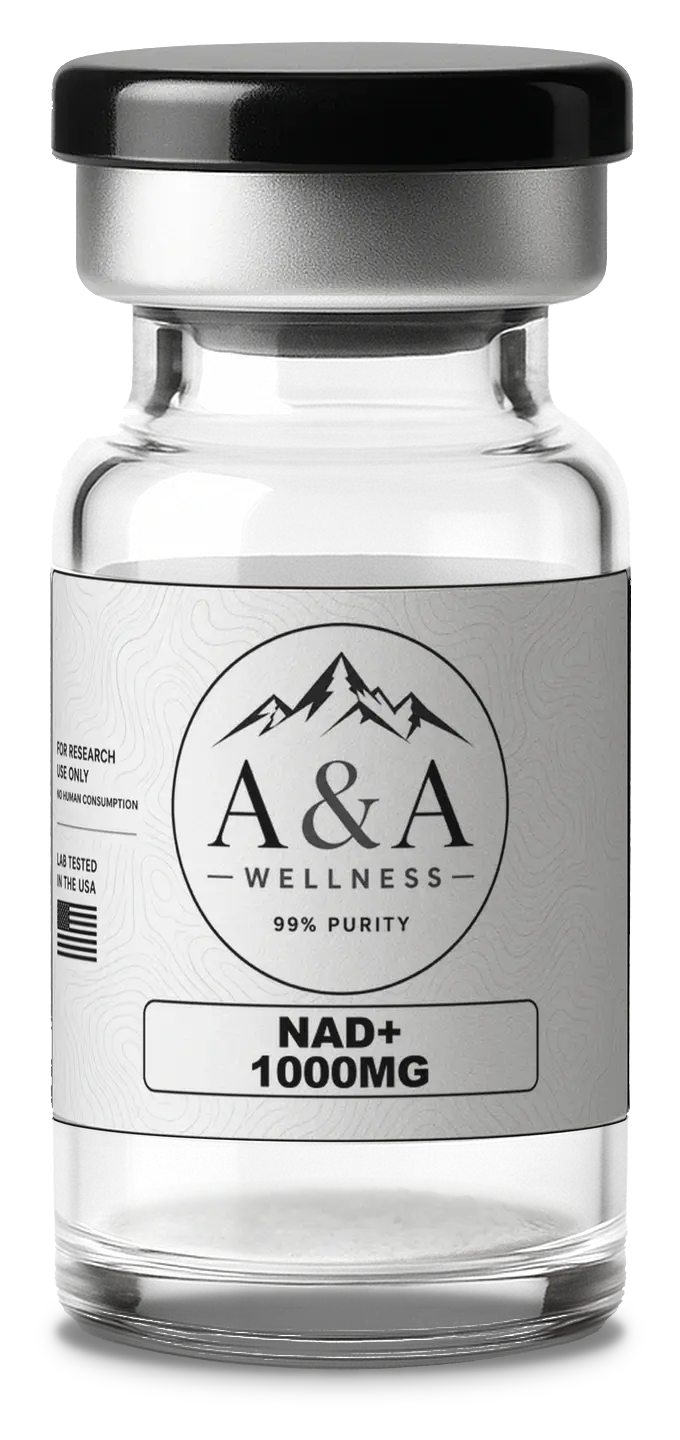
A&A Wellness supplies NAD+ 1000mg as a lyophilized research material. It is not a drug, food, cosmetic or dietary supplement, and it is not for human or veterinary use.
Classification and structure
A dinucleotide
As its name says, NAD+ is made of two nucleotides joined through their phosphate groups:
- Adenine nucleotide. Adenine attached to ribose and phosphate (the same building block found in ATP).
- Nicotinamide nucleotide. Nicotinamide, a form of vitamin B3, attached to ribose and phosphate.
The nicotinamide ring is the reactive part in redox chemistry. It accepts a hydride (two electrons and a proton) to form NADH, the reduced form, and donates it back in later reactions. The “+” in NAD+ refers to the positive charge on the nicotinamide nitrogen in the oxidized form.
Related molecules
The literature on NAD+ also covers its precursors and intermediates, notably nicotinamide mononucleotide (NMN) and nicotinamide riboside (NR). Cells can convert these into NAD+ (Yoshino, Baur & Imai, Cell Metab 2018). Much of the research described below studies these precursors rather than NAD+ itself. The distinction matters when reading any study.
Roles described in the literature
Redox metabolism
NAD+/NADH is the main hydrogen carrier in glycolysis, the tricarboxylic acid cycle and the delivery of electrons to the mitochondrial electron transport chain. Rajman and colleagues call NAD+ “the cell’s hydrogen carrier for redox enzymes” (Rajman et al., Cell Metab 2018).
NAD+-consuming enzymes
Several enzyme families consume NAD+ rather than cycling it:
- Sirtuins. NAD+-dependent deacylases involved in regulating gene expression and metabolism.
- PARPs (poly(ADP-ribose) polymerases). Enzymes involved in DNA damage responses.
- CD38. A major NAD+-degrading enzyme (NAD+ glycohydrolase) in many tissues.
Covarrubias and colleagues’ 2021 review in Nature Reviews Molecular Cell Biology describes how, through these enzymes, NAD+ influences metabolic pathways, DNA repair, chromatin remodelling, cellular senescence and immune cell function (Covarrubias et al., 2021).
A signalling molecule
Beyond metabolism, reviews describe NAD+ as a signalling molecule whose levels respond to food intake, exercise and time of day (Rajman et al., 2018).
Research history and key published studies
Foundational biochemistry
NAD+ is one of the oldest-known coenzymes. Its roles in fermentation and oxidative metabolism were worked out over the twentieth century and are standard in biochemistry textbooks. Recent interest centres on its consuming enzymes and on how cellular NAD+ levels are regulated.
NAD+ levels in model organisms
Several major reviews report that tissue and cellular NAD+ levels change with age in model organisms. Covarrubias and colleagues describe a gradual decline in NAD+ levels across multiple organisms, including rodents and humans (Covarrubias et al., 2021). Rajman and colleagues review animal studies in which NAD+ levels were manipulated experimentally (Rajman et al., 2018).
Mostly animal and precursor research. The same reviews identify open questions about the mechanisms that regulate NAD+ and how findings in animals translate to humans (Covarrubias et al., 2021). Much of the in vivo work uses the precursors NMN and NR rather than NAD+ itself (Yoshino et al., 2018).
Metabolome measurement in a pilot study (2019)
Studies that look directly at NAD+ itself are fewer. A 2019 pilot study by Grant and colleagues measured how the NAD+ metabolome in plasma and urine changed over a six-hour intravenous infusion of NAD+ in a small group of adult participants. They reported that plasma NAD+ and its metabolites did not change until after two hours, which suggests NAD+ was rapidly removed from plasma at first. The metabolite pattern they observed was consistent with the activity of NAD+-degrading enzymes (Grant et al., Front Aging Neurosci 2019). This was a small pharmacokinetic pilot, not an efficacy trial, and we report it only as part of the research record.
Open questions in the literature
Precursor versus NAD+ itself
Much of the in vivo literature studies precursors such as NMN and NR rather than NAD+ (Yoshino et al., 2018; Rajman et al., 2018). NAD+ is a relatively large, charged molecule. How intact extracellular NAD+ is handled compared with its precursors is an active research question. The 2019 metabolome pilot observed rapid early clearance from plasma and metabolite patterns consistent with enzymatic breakdown (Grant et al., 2019).
Compartments
NAD+ exists in separate pools in the cytosol, mitochondria and nucleus. Reviews note that measuring total tissue NAD+ does not show how these compartments are regulated individually (Covarrubias et al., 2021).
Consumption versus synthesis
Whether changes in NAD+ levels in models reflect reduced synthesis or increased consumption, for example by CD38 or PARPs, is discussed extensively in the review literature. The answer may differ by tissue and condition (Covarrubias et al., 2021).
Measurement
NAD+ and NADH interconvert and degrade during sample handling. Quantification therefore depends heavily on extraction and analytical method, which makes it hard to compare results across studies. For research material, batch identity and purity documentation matter. See how to read a COA.
Regulatory status
- FDA 503A compounding categories. FDA’s list of bulk drug substances nominated for use in compounding under section 503A (updated May 14, 2026) places nicotinamide adenine dinucleotide (NAD) and nicotinamide adenine dinucleotide disodium reduced (NADH) in Category 1, “Bulk Drug Substances Under Evaluation.” “Beta-nicotinamide adenine dinucleotide disodium salt trihydrate” appears in Category 3, nominated without adequate support (FDA 503A categories). These categories govern what compounding pharmacies may use. They are not drug approvals.
- A&A Wellness material. Our NAD+ 1000mg is a research material only. It is not a medicine, supplement or cosmetic, and it is not for human or veterinary use.
See our regulatory overview. It is general information, not legal advice.
Handling and storage in the lab
General conventions; follow your SOPs.
- Store the lyophilized powder sealed, cold, dry and dark. NAD+ is hygroscopic, meaning it absorbs moisture, so keep vials tightly closed.
- Equilibrate before opening to limit condensation on the powder.
- Solutions are less stable. NAD+ in solution degrades over time, and its stability depends on pH and temperature. Many labs prepare solutions close to use or freeze single-use aliquots.
- Protect from light and avoid repeated freeze-thaw cycles. Label aliquots with concentration, date and batch.
- Diluent choice. Choose a diluent compatible with your assay. See our comparison of bacteriostatic vs sterile water.
Our peptide storage guide covers general cold-chain and aliquoting practice.
Research-use notice
All A&A Wellness products are for research use only. They are not for human or veterinary use and are not a drug, food, cosmetic or dietary supplement. This page summarizes published research for education. It does not suggest that NAD+ has any established effect when given to people or that anyone should use it. Please read our Research Use Policy before ordering.
Related resources
- Product: NAD+ 1000mg
- Related compounds: MOTS-c, SS-31, both studied in mitochondrial research
- Background: What are research peptides?
- Category: NAD+
- Quality: Our quality standards
Sources
- Verdin E. NAD+ in aging, metabolism, and neurodegeneration. Science. 2015;350(6265):1208-1213.
- Rajman L, Chwalek K, Sinclair DA. Therapeutic Potential of NAD-Boosting Molecules: The In Vivo Evidence. Cell Metab. 2018;27(3):529-547.
- Yoshino J, Baur JA, Imai SI. NAD+ Intermediates: The Biology and Therapeutic Potential of NMN and NR. Cell Metab. 2018;27(3).
- Grant R, et al. A Pilot Study Investigating Changes in the Human Plasma and Urine NAD+ Metabolome During a 6 Hour Intravenous Infusion of NAD+. Front Aging Neurosci. 2019;11:257.
- Covarrubias AJ, Perrone R, Grozio A, Verdin E. NAD+ metabolism and its roles in cellular processes during ageing. Nat Rev Mol Cell Biol. 2021;22(2):119-141.
- U.S. FDA. Bulk Drug Substances Nominated for Use in Compounding Under Section 503A of the FD&C Act (updated May 14, 2026).