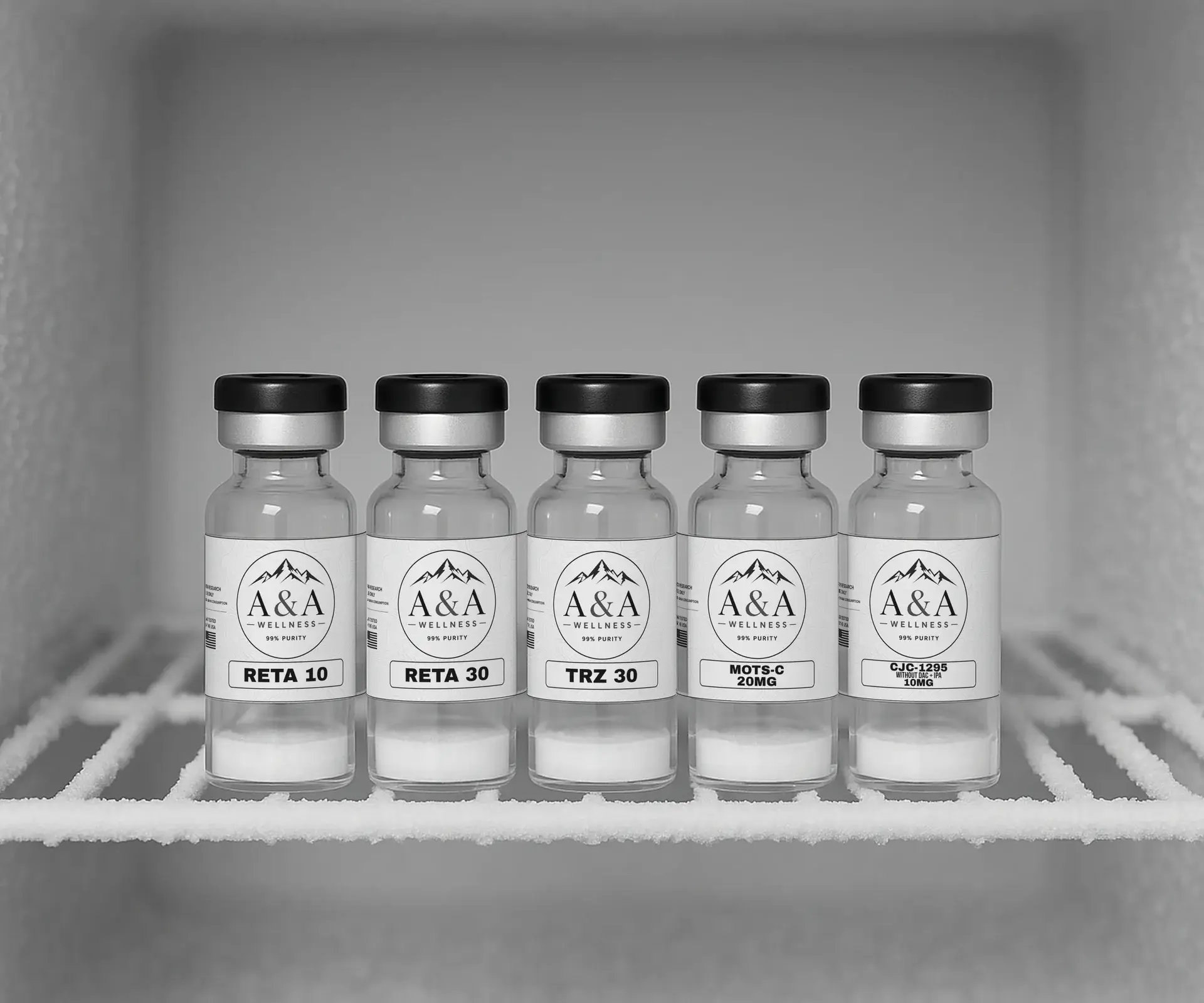
Peptides sit at the center of a large and fast-moving area of laboratory science. Yet the term “research peptide” is often used loosely, and it is easy to lose sight of what the words actually mean. This guide covers the fundamentals: what a peptide is, how research-grade peptides are made, what the research-use-only label means, and how to judge whether a product is documented well enough for serious work.
What Is a Peptide?
A peptide is a short chain of amino acids. Each amino acid is joined to the next by a peptide bond, a covalent link between the carboxyl group of one residue and the amino group of the next. The sequence of amino acids, read from the N-terminus to the C-terminus, defines the peptide.
Size is the main distinction from proteins. By common convention, chains of roughly 2 to 50 amino acids are called peptides. Longer chains that fold into complex three-dimensional structures are generally called proteins. The cut-off is a convention, not a hard rule, and you will see it drawn differently in different textbooks.
Common structural terms
- Residue. A single amino acid unit within the chain.
- Sequence. The ordered list of residues, usually written with one- or three-letter codes.
- Modification. A chemical change to the basic chain, such as C-terminal amidation, acetylation, a lipid attachment, or a bound metal ion. GHK-Cu, for example, is a tripeptide complexed with copper. See our GHK-Cu compound overview.
- Analog. A peptide deliberately altered from a naturally occurring sequence, for example by substituting residues. IGF-1 LR3 is a well-known analog of a native sequence.
Why Peptides Are Studied
Peptides occur naturally throughout biology as signaling molecules, hormones, and fragments of larger proteins. Their specificity makes them a major focus of pharmaceutical and academic research. A 2022 review in Signal Transduction and Targeted Therapy by Wang and colleagues describes how advances in production, modification, and analytical technologies have driven substantial progress in peptide drug development over the past decade.
Research spans many compound classes. Examples include incretin-receptor agonists such as tirzepatide and retatrutide, growth-hormone secretagogues such as tesamorelin and ipamorelin, mitochondria-associated peptides such as MOTS-c and SS-31, and short synthetic sequences such as Selank and Semax.
Each compound page in our education library describes classification, structure, and what published research reports, with citations.
How Research Peptides Are Made
Solid-phase peptide synthesis
Most research peptides are synthesized chemically. The dominant approach, solid-phase peptide synthesis (SPPS), was introduced by R. Bruce Merrifield in a 1963 paper in the Journal of the American Chemical Society. The first amino acid is anchored to an insoluble resin, and further residues are added one at a time. Excess reagents are washed away between steps.
Synthesis is not perfectly efficient. At each coupling step a small fraction of chains may fail to extend, or may carry a leftover protecting group. The crude product therefore contains the target peptide plus closely related impurities, such as sequences missing a single residue.
Purification and lyophilization
Crude peptide is purified, usually by preparative reversed-phase HPLC. This separates the target sequence from most synthesis by-products. The purified fractions are then freeze-dried into a solid, typically a white to off-white powder or “cake” in the vial.
The final solid is usually a salt. Trifluoroacetic acid (TFA) is commonly used during cleavage and HPLC purification, so peptides frequently end up as trifluoroacetate salts, as JPT Peptide Technologies notes in its technical resources. This matters later when you calculate concentrations, because the weighed powder is not 100% peptide. Our HPLC and mass spectrometry guide explains the difference between purity and net peptide content.
What “Research Use Only” Means
RUO is a statement of intended use. A research-use-only material is supplied for laboratory and in-vitro research. It is not a drug, food, cosmetic, or dietary supplement. It is not for human or veterinary use.
RUO materials are not FDA-approved products. Some research compounds share a name with the active ingredient of an approved prescription drug. Tirzepatide, for instance, is the active ingredient in FDA-approved prescription medicines. Other compounds, such as retatrutide, are investigational and not approved by the FDA for any use. In every case, a research-grade material is not the approved drug. It has not been manufactured, tested, or labeled under the drug-approval framework.
The label shapes how a lab should handle the material. Treat RUO peptides as laboratory reagents: log them into inventory, store them to the supplier’s stated conditions, document preparation steps, and keep them out of any setting where they could be mistaken for a consumable. Our Research Use Policy sets out A&A Wellness’s terms in full.
Forms You Will Encounter
Lyophilized powder
Nearly all research peptides, including those in our Research Peptides and Research Blends categories, are supplied as lyophilized powder in sealed glass vials. The dry state slows the chemical reactions that degrade peptides in water. See Lyophilized Peptides Explained.
Blends
A blend is more than one compound in a single vial. For example, the GLOW Blend combines GHK-Cu, BPC-157, and TB-500 in stated amounts. When working with a blend, record the amount of each component, not just the vial total, and check that documentation addresses each component.
Related non-peptide materials
Not everything on a peptide supplier’s shelf is a peptide. NAD+ is a coenzyme (a dinucleotide), not an amino-acid chain. Bacteriostatic water is a diluent used in the lab to prepare solutions. Our bacteriostatic vs sterile water guide covers when each is appropriate.
Evaluating Quality: What to Look For
Identity and purity are separate questions. Identity asks, “Is this the right molecule?” Mass spectrometry answers it by confirming molecular mass. Purity asks, “How much of the peptide material is the target sequence?” HPLC answers it by separating the target from related impurities.
A certificate of analysis ties both answers to a batch. A useful COA names the compound, the lot number, the test methods, the results, the acceptance criteria, and the date. It should match the lot printed on the vial. Our step-by-step guide to reading a COA shows what each section means and which red flags to watch for.
Be wary of unsupported claims. A purity percentage with no lot number, chromatogram, or test date is a marketing statement, not documentation. Every A&A Wellness product is guaranteed to meet 99% purity and is lab tested in the USA. Our quality standards page explains the approach.
Handling Basics for New Labs
- Store on arrival. Move vials to the storage condition on the label as soon as they arrive. General conventions are covered in our peptide storage guide.
- Equilibrate before opening. Let cold vials reach room temperature before opening to limit moisture condensing on the powder, a precaution Bachem’s handling guidelines recommend.
- Prepare solutions only when needed. Peptides are generally less stable in solution. Our guide to reconstituting peptides for laboratory use covers aseptic technique and concentration math.
- Label everything. Compound, lot, concentration, diluent, preparation date, and initials belong on every prepared vial.
Key Takeaways
- Peptides are short amino-acid chains, most commonly made by solid-phase synthesis and purified by HPLC.
- “Research use only” means laboratory research, not human or veterinary use, and not an FDA-approved product.
- Identity (mass spectrometry) and purity (HPLC) are distinct, and both should be documented for a specific lot.
- Good handling starts with correct storage, careful equilibration, and clear labeling.
Ready to browse? Start with our Research Peptides category, or explore the full education library.
Sources
- Wang L, et al. Therapeutic peptides: current applications and future directions. Signal Transduct Target Ther. 2022
- Merrifield RB. Solid Phase Peptide Synthesis. I. The Synthesis of a Tetrapeptide. J Am Chem Soc. 1963
- Bachem. Handling and Storage Guidelines for Peptides
- JPT Peptide Technologies. About Peptide Purity