What Selank is
Selank is a synthetic seven-amino-acid peptide (a heptapeptide) developed at the Institute of Molecular Genetics of the Russian Academy of Sciences. Its sequence is Thr-Lys-Pro-Arg-Pro-Gly-Pro, usually written TKPRPGP.
Researchers designed it as an analog of tuftsin, a short peptide first described by Victor Najjar and colleagues in the late 1960s. The published literature describes Selank mainly in neuroscience and immunology research. Much of that literature comes from Russian research groups.
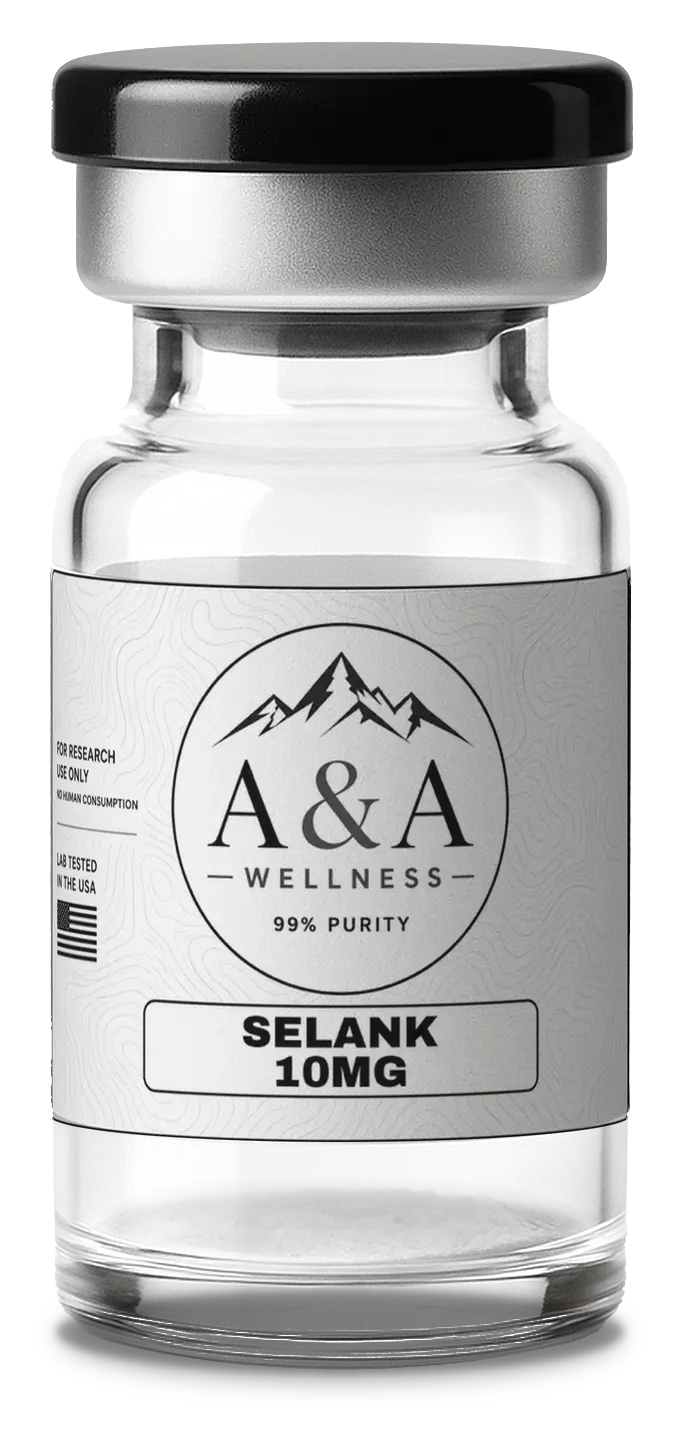
The material A&A Wellness supplies as Selank is a synthetic research peptide for laboratory use. It is not a drug, food, cosmetic or dietary supplement, and it is not for human or veterinary use.
Classification and structure
Built on tuftsin
Tuftsin is the tetrapeptide Thr-Lys-Pro-Arg (TKPR). It corresponds to a fragment of the heavy chain of immunoglobulin G. Tuftsin has been studied for decades, mostly for its effects on phagocytic cells. A 1999 review marking 30 years since Najjar’s discovery surveyed its occurrence, synthesis, receptor studies and many synthetic analogs (Siemion & Kluczyk, Peptides 1999).
The Pro-Gly-Pro extension
Selank is tuftsin extended at the C-terminus by three natural L-amino acids, Pro-Gly-Pro. The developers’ group has described that extension as a way to improve the peptide’s metabolic stability (Volkova et al., Front Pharmacol 2016). The same Pro-Gly-Pro tail appears in Semax, a related peptide from the same institute.
Research material
Research-grade Selank is produced by chemical peptide synthesis and supplied as a lyophilized (freeze-dried) powder. It is often supplied as the acetate salt, which is how it appears in FDA’s documents (“selank acetate (TP-7)”). Our guide to lyophilized peptides explains that format.
Mechanism as described in the literature
No single mechanism for Selank is established. The literature proposes several, mostly from animal and in vitro work. These are research hypotheses.
Enkephalinase inhibition
A 2001 study reported that Selank and Semax inhibited enkephalin-degrading enzymes in human serum in vitro. The effect was dose-dependent. The authors proposed that slowing the breakdown of regulatory peptides such as enkephalins may be one route by which Selank acts (Kost et al., Bioorg Khim 2001).
GABAergic gene expression
In a 2016 rat study, Volkova and colleagues compared gene expression in the frontal cortex after Selank or GABA was given. They reported that 45 genes changed in mRNA level one hour later. The changes under Selank correlated with those under GABA. The authors discussed possible allosteric modulation of GABA-A receptors as one interpretation (Volkova et al., 2016).
Immune signalling
Selank’s parent, tuftsin, is best known for its effects on phagocytic immune cells (Siemion & Kluczyk, 1999). That lineage is why Selank is often described in both immunological and neurological terms. How those two lines of research fit together has not been resolved in the literature.
Research history and key published studies
Early clinical reports in Russia
Most human data on Selank come from clinical studies published in Russian-language journals. In 2008, Zozulia and colleagues reported a comparison of Selank and medazepam in 62 patients with generalized anxiety disorder or neurasthenia. They also measured enkephalin-degrading activity in blood serum (Zozulia et al., 2008).
A 2014 study by Medvedev and colleagues compared Selank with phenazepam in 60 patients with anxiety-spectrum and somatoform disorders (Medvedev et al., 2014).
Reading these studies. These trials were small, were run largely within the developers’ own research network, and were published mostly in Russian. We report what the authors wrote without drawing conclusions about effects in people.
Animal and gene-expression studies
Recent English-language work is mostly preclinical:
- Frontal cortex gene expression (2016). The GABA comparison study in rats described above (Volkova et al., 2016).
- Combination with diazepam (2017). In a rat model of unpredictable chronic mild stress, Kasian and colleagues reported that combining Selank with diazepam gave the largest reduction in anxiety-like behaviour in the elevated plus maze. The effect differed with the stress condition (Kasian et al., Behav Neurol 2017).
Independent commentary
Scrutiny from outside that network is limited. A 2021 review in the Journal of Clinical Pharmacology by Doyno and White covered several GABA-active agents. It described phenibut and Selank as “poorly studied Russian drugs with GABAergic mechanisms” that were being sold to US consumers as dietary supplements. The authors called for abuse potential to be evaluated before public access (Doyno & White, 2021).
Overall evidence base. The literature combines preclinical studies with small clinical reports from one country. Large, independent, controlled trials published in international journals are lacking.
Open questions in the literature
Anyone evaluating the Selank literature will run into several unresolved issues.
Which mechanism matters?
Enkephalinase inhibition, GABAergic gene-expression changes and tuftsin-like immune activity have all been proposed. The published studies do not show which of these, if any, accounts for the behavioural findings reported in animals. Each proposal also rests on a small number of papers.
Stability and metabolites
The Pro-Gly-Pro extension was added to slow degradation. Shorter fragments of Selank and Semax behaved differently from the full heptapeptides in the 2001 enzyme study: pentapeptide fragments kept inhibitory activity and shorter fragments did not (Kost et al., 2001). That raises the question of how much of the reported activity belongs to Selank itself and how much to its breakdown products.
Replication
The Selank literature is concentrated in one network of institutes and in Russian-language journals. Independent replication in other countries, using characterized material and pre-registered designs, would be needed before any finding could be treated as established.
Material identity
Selank is sold in several salt forms and by many suppliers. That makes batch-level identity and purity data essential for any study. See how to read a COA for what that documentation should show.
Regulatory status
- United States: not an approved drug. Selank is not FDA-approved for any use and is not the active ingredient in any FDA-approved medicine.
- FDA 503A compounding categories. In its September 2023 update, FDA added selank acetate (TP-7) to Category 2, bulk drug substances that raise significant safety concerns. FDA’s safety-risk page states that compounded drugs containing selank acetate “may pose risk for immunogenicity for certain routes of administration due to the potential for aggregation and peptide-related impurities.” It also notes limited information on safety in humans. As of the page’s April 22, 2026 update, selank acetate is listed among nominations that were withdrawn (FDA). Selank was not among the seven peptides FDA’s Pharmacy Compounding Advisory Committee reviewed in July 2026.
- Russia. The peer-reviewed literature describes Selank as a drug used in Russia, and several Russian clinical studies compare it with established anxiolytics (Doyno & White, 2021). Registration in another country has no bearing on its status in the US.
- A&A Wellness material. Our Selank is research material only. It is not a medicine and is not for human or veterinary use.
For background, see our research peptides regulatory overview. It is general information, not legal advice.
Handling and storage in the lab
These are general conventions for lyophilized peptides. Always follow your laboratory’s SOPs.
- Store sealed and cold. Keep unopened vials of lyophilized Selank sealed, dry and protected from light. Freezer storage is common for long-term holding.
- Equilibrate before opening. Let the vial reach room temperature while still sealed. This limits moisture condensing on the powder.
- Prepare solutions aseptically. Use clean technique and an assay-appropriate diluent (see our comparison of bacteriostatic vs sterile water). Our reconstitution guide covers general bench technique.
- Aliquot and label. Split solutions into single-use aliquots to avoid repeated freeze-thaw cycles. Label each with compound, concentration, date and batch.
Our peptide storage guide covers these practices in more detail.
Research-use notice
All A&A Wellness products are for research use only. They are not for human or veterinary use and are not a drug, food, cosmetic or dietary supplement. This page summarizes published research for educational purposes. It does not suggest that Selank has any established effect in people or that anyone should use it. Please read our Research Use Policy before ordering.
Related resources
- Product page: Selank
- Related compound: Semax
- Comparison guide: Selank vs Semax
- Background: What are research peptides?
- Category: Research Peptides
- Quality: Our quality standards
Sources
- Siemion IZ, Kluczyk A. Tuftsin: on the 30-year anniversary of Victor Najjar's discovery. Peptides. 1999;20(5):645-674.
- Kost NV, et al. Semax and selank inhibit the enkephalin-degrading enzymes from human serum. Bioorg Khim. 2001;27(3):180-183.
- Zozulia AA, et al. Efficacy and possible mechanisms of action of a new peptide anxiolytic selank in the therapy of generalized anxiety disorders and neurasthenia. Zh Nevrol Psikhiatr Im S S Korsakova. 2008;108(4):38-48.
- Medvedev VE, et al. A comparison of the anxiolytic effect and tolerability of selank and phenazepam in the treatment of anxiety disorders. Zh Nevrol Psikhiatr Im S S Korsakova. 2014;114(7):17-22.
- Volkova A, et al. Selank Administration Affects the Expression of Some Genes Involved in GABAergic Neurotransmission. Front Pharmacol. 2016;7:31.
- Kasian A, et al. Peptide Selank Enhances the Effect of Diazepam in Reducing Anxiety in Unpredictable Chronic Mild Stress Conditions in Rats. Behav Neurol. 2017;2017:5091027.
- Doyno CR, White CM. Sedative-Hypnotic Agents That Impact Gamma-Aminobutyric Acid Receptors: Focus on Flunitrazepam, Gamma-Hydroxybutyric Acid, Phenibut, and Selank. J Clin Pharmacol. 2021;61 Suppl 2:S114-S128.
- U.S. FDA. Certain Bulk Drug Substances for Use in Compounding that May Present Significant Safety Risks.