What Semax is
Semax is a synthetic heptapeptide with the sequence Met-Glu-His-Phe-Pro-Gly-Pro (MEHFPGP). It was developed from the 1980s onward at the Institute of Molecular Genetics in Moscow. Igor Ashmarin’s group described its design and early study in a 1997 review of 15 years of work (Ashmarin et al., 1997).
Semax has been studied mainly in neuroscience: learning and memory models, and models of cerebral ischemia. Most of the research comes from Russian groups linked to the institute that developed it.
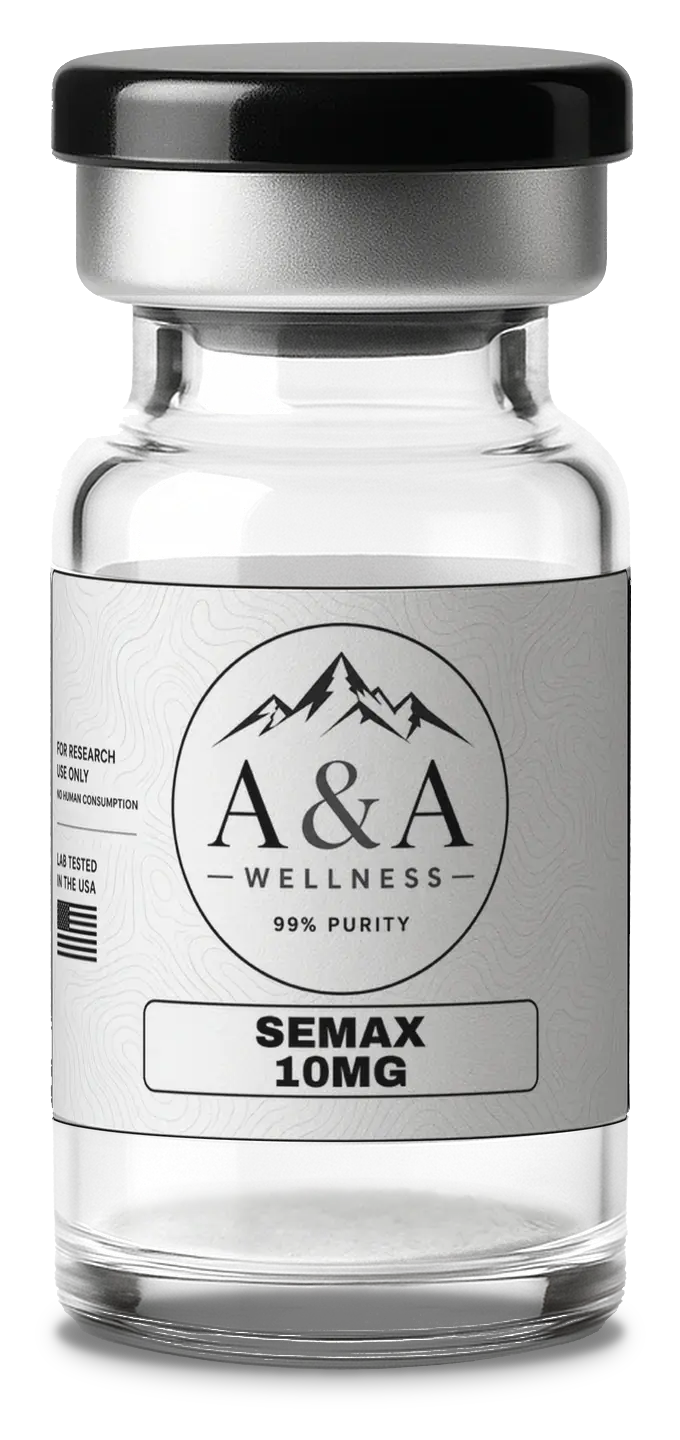
The material A&A Wellness supplies as Semax is a synthetic research peptide for laboratory use. It is not a drug, food, cosmetic or dietary supplement, and it is not for human or veterinary use.
Classification and structure
An ACTH fragment plus a stabilizing tail
Adrenocorticotropic hormone (ACTH) is a 39-amino-acid pituitary hormone. Semax takes residues 4 to 7 of ACTH (Met-Glu-His-Phe) and adds the tripeptide Pro-Gly-Pro to the C-terminus.
Why two names appear. Some papers call Semax an “ACTH(4-10) analog” (Dolotov et al., Brain Res 2006). Others describe it as ACTH(4-7)PGP (Radchenko et al., Acta Naturae 2025). Both describe the same molecule. The first name reflects the ACTH(4-10) fragment the design started from. The second describes the sequence exactly.
No hormonal activity reported
The ACTH(4-7) fragment does not include the parts of ACTH that stimulate the adrenal cortex. The developers’ group states that “Semax does not exhibit any hormonal activity” (Radchenko et al., 2025).
Related to Selank
The same institute developed Selank, which carries the same Pro-Gly-Pro extension on a different parent peptide (tuftsin). Our Selank vs Semax guide compares them side by side.
Mechanism as described in the literature
The proposed mechanisms of Semax come mostly from rodent and in vitro studies. They are research hypotheses, not established human pharmacology.
Neurotrophin signalling (BDNF/TrkB)
The most cited mechanistic study is Dolotov and colleagues’ 2006 paper in Brain Research. They reported that in the rat hippocampus, Semax increased levels of brain-derived neurotrophic factor (BDNF) protein and phosphorylation of its receptor TrkB, along with the corresponding mRNAs. The authors concluded that Semax “affects cognitive brain functions by modulating the expression and the activation of the hippocampal BDNF/trkB system” (Dolotov et al., 2006).
Immune and vascular gene expression in ischemia models
In 2014, Medvedeva and colleagues ran a genome-wide transcriptional analysis in rats with experimental focal brain ischemia. They reported that Semax mainly increased expression of genes related to the immune system and to the vascular system, at 3 and 24 hours after arterial occlusion. The authors proposed that these immune and vascular effects may underlie the neuroprotective activity reported in such models (Medvedeva et al., BMC Genomics 2014).
Enkephalinase inhibition
A 2001 in vitro study reported that Semax, like Selank, inhibited enkephalin-degrading enzymes in human serum. The authors suggested that slower breakdown of regulatory peptides could be one mechanism behind its reported activity (Kost et al., 2001).
Research history and key published studies
Design and early work (1980s–1990s)
Ashmarin’s 1997 review summarized the program’s first 15 years. It reported that in experimental animals and in humans, Semax had been associated with effects on memory and attention and on resistance to hypoxia (Ashmarin et al., 1997). That review was written by the developers and is not an independent assessment.
Clinical reports in ischemic stroke (1997)
Gusev and colleagues reported a study of 30 patients with acute ischemic stroke who received Semax on top of standard therapy. They were compared with 80 patients on conventional therapy alone, using EEG and evoked-potential monitoring. The authors reported some influence on the rate at which neurological functions were restored (Gusev et al., 1997). This was an early, small, non-randomized comparison published in Russian.
Molecular studies (2006 onward)
Later work focused on mechanism: the BDNF/TrkB paper (Dolotov et al., 2006), transcriptomic studies in ischemia models (Medvedeva et al., 2014), and more recent work on Semax and a derivative in models of pathological impairment (Radchenko et al., 2025).
Overall evidence base. Most of the literature is preclinical and comes from one research network. The human data are mainly older, small Russian clinical studies. Large, independent, randomized controlled trials published in international journals are lacking.
Open questions in the literature
ACTH fragment without ACTH activity
Semax keeps part of the ACTH sequence, but its developers report that it has no hormonal activity. The literature has not settled which receptors, if any, mediate its reported effects. Proposals range from neurotrophin signalling to changes in gene expression and inhibition of peptide-degrading enzymes (Dolotov et al., 2006; Kost et al., 2001).
The role of Pro-Gly-Pro
The C-terminal Pro-Gly-Pro tripeptide is not just a stabilizer. Researchers in the developers’ network have studied it as a biologically active fragment in its own right (Dmitrieva et al., Cell Mol Neurobiol 2010). That makes it harder to attribute findings to the intact heptapeptide rather than to its breakdown products.
Gene-expression studies
Transcriptomic studies in rat ischemia models report broad changes in immune and vascular gene expression (Medvedeva et al., 2014). Gene-expression changes are not the same as functional outcomes, however. These datasets generate hypotheses rather than confirm mechanisms.
Independent replication
As with Selank, most Semax studies come from one research community. Independent, controlled studies with fully characterized material would strengthen the evidence base. Batch documentation matters here too: see how to read a COA.
Regulatory status
- United States: not an approved drug. Semax is not FDA-approved for any use and is not the active ingredient in any FDA-approved medicine.
- FDA 503A categories. In September 2023, FDA added Semax (heptapeptide) to Category 2 of its 503A bulk drug substance categories, substances that raise significant safety concerns. FDA’s safety-risk page states that compounded drugs containing Semax “may pose risk for immunogenicity for certain routes of administration due to the potential for aggregation and peptide-related impurities.” As of the page’s April 22, 2026 update, the Semax nomination is listed as withdrawn (FDA).
- July 2026 advisory committee. At its July 23–24, 2026 meeting, FDA’s Pharmacy Compounding Advisory Committee voted to recommend adding Semax, along with five other peptides, to the 503A bulks list. As legal commentators noted, “an advisory committee vote is not an agency action.” At the time of writing FDA had not made a final decision (Mintz, July 2026). Any future listing would concern pharmacy compounding only. It would not make Semax an FDA-approved drug.
- Russia. Semax is a medicine in Russia. A 2025 peer-reviewed paper reports that it is on the Russian List of Vital and Essential Drugs for Medical Application (Radchenko et al., 2025).
- A&A Wellness material. Our Semax is research material only, not for human or veterinary use.
See our regulatory overview for more context. It is general information, not legal advice.
Handling and storage in the lab
General conventions for lyophilized peptides. Always follow your laboratory’s SOPs.
- Cold, dry, dark. Store sealed vials of lyophilized Semax protected from moisture and light. Freezer storage is common for long-term holding.
- Mind oxidation. The N-terminal methionine can oxidize. Keep air exposure of powder and solutions to a minimum and close vials promptly.
- Equilibrate before opening. Let the sealed vial reach room temperature first so condensation does not form on the powder.
- Aseptic preparation. Prepare solutions using clean technique and a diluent suited to the assay. See our reconstitution guide and our comparison of bacteriostatic and sterile water.
- Aliquot. Divide solutions into single-use aliquots, label them, and avoid repeated freeze-thaw cycles.
Our peptide storage guide covers these steps in more depth.
Research-use notice
All A&A Wellness products are for research use only. They are not for human or veterinary use and are not a drug, food, cosmetic or dietary supplement. This article summarizes published research for education. It does not suggest that Semax has any established effect in people or that anyone should use it. Please review our Research Use Policy before ordering.
Related resources
- Product page: Semax
- Related compound: Selank
- Comparison guide: Selank vs Semax
- Background: What are research peptides?
- Category: Research Peptides
- Quality: Our quality standards
Sources
- Ashmarin IP, et al. A nootropic adrenocorticotropin analog 4-10-semax (15 years experience in its design and study). Zh Vyssh Nerv Deiat Im I P Pavlova. 1997;47(2):420-430.
- Gusev EI, et al. Effectiveness of semax in acute period of hemispheric ischemic stroke (a clinical and electrophysiological study). Zh Nevrol Psikhiatr Im S S Korsakova. 1997;97(6):26-34.
- Kost NV, et al. Semax and selank inhibit the enkephalin-degrading enzymes from human serum. Bioorg Khim. 2001;27(3):180-183.
- Dolotov OV, et al. Semax, an analog of ACTH(4-10) with cognitive effects, regulates BDNF and trkB expression in the rat hippocampus. Brain Res. 2006;1117(1):54-60.
- Medvedeva EV, et al. The peptide semax affects the expression of genes related to the immune and vascular systems in rat brain focal ischemia: genome-wide transcriptional analysis. BMC Genomics. 2014;15:228.
- Radchenko AI, et al. The Potential of the Peptide Drug Semax and Its Derivative for Correcting Pathological Impairments. Acta Naturae. 2025.
- U.S. FDA. Certain Bulk Drug Substances for Use in Compounding that May Present Significant Safety Risks.
- Mintz. FDA's Advisory Committee Votes on Peptides (Viewpoint, July 29, 2026).