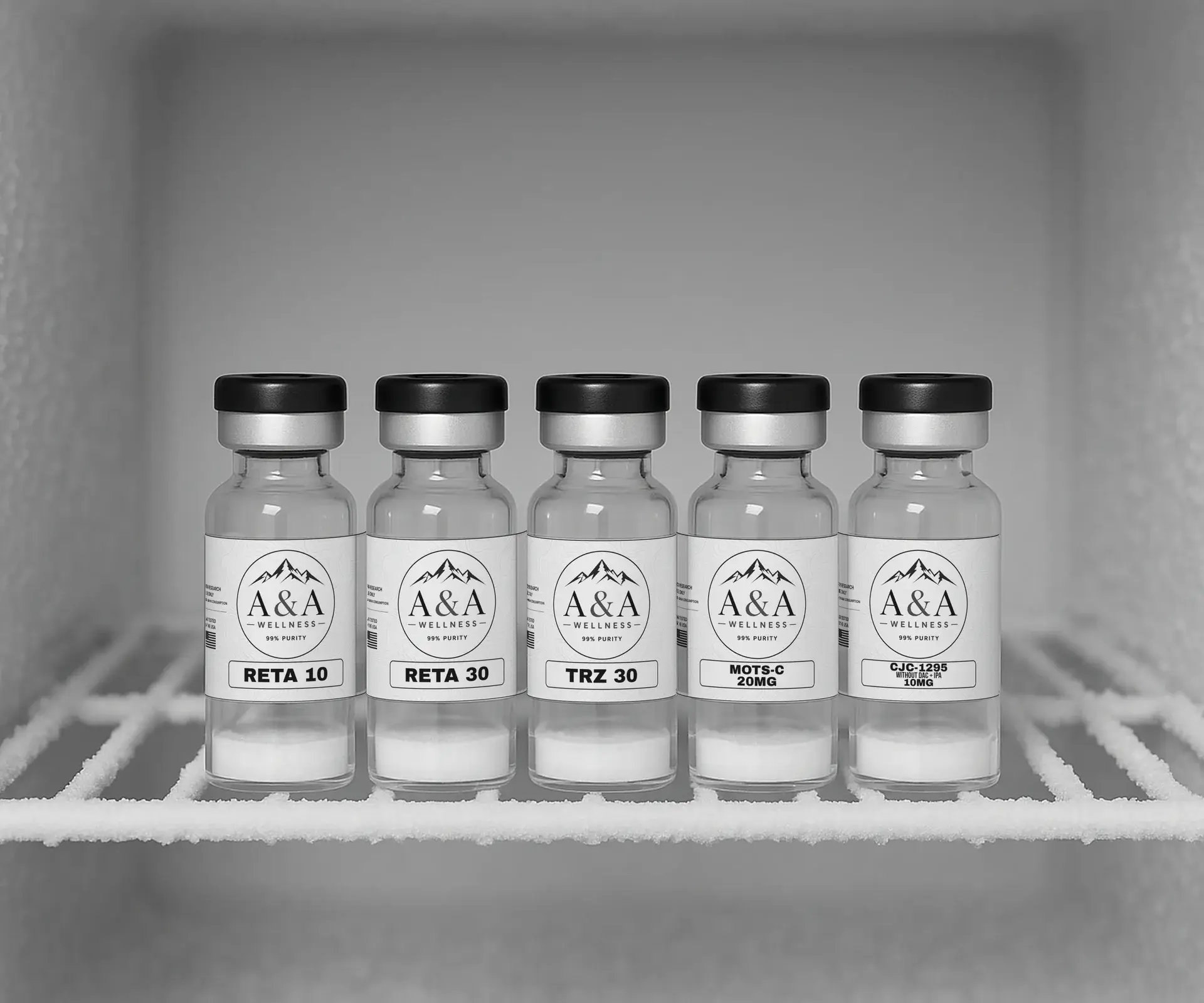
What retatrutide is
Retatrutide is a synthetic peptide first described in the scientific literature under the development code LY3437943. It was designed by Eli Lilly and Company as a single molecule able to activate three hormone receptors involved in nutrient signalling: the glucose-dependent insulinotropic polypeptide (GIP) receptor, the glucagon-like peptide-1 (GLP-1) receptor and the glucagon receptor. For that reason it is usually described as a “triple agonist” or “triple hormone receptor agonist.”
It is an investigational compound. Retatrutide has not been approved by the U.S. Food and Drug Administration (FDA) or any other regulator for any use. The research material A&A Wellness supplies as Retatrutide (RETA) is sold for laboratory research only and is not a drug, food, cosmetic or dietary supplement.
This page summarizes how the compound is classified, how its pharmacology has been characterized, and what peer-reviewed studies have reported. It is written for researchers and informed readers, and it deliberately contains no dosing or use guidance.
Classification and structure
A member of the incretin-based peptide family
Retatrutide belongs to a family of engineered peptides built around the incretin hormones, GIP and GLP-1, which are released from the gut after a meal. Earlier compounds in this family activated only the GLP-1 receptor. The next generation, represented by tirzepatide, added GIP receptor activity. Retatrutide extends that design by adding a third target, the glucagon receptor.
Structural features described in the literature
In the 2022 discovery paper, Coskun and colleagues described LY3437943 as a single peptide with a fatty diacid moiety attached, a modification that promotes reversible binding to serum albumin and slows clearance (Coskun et al., Cell Metab 2022). The same lipidation strategy had been used earlier for tirzepatide (then called LY3298176) (Coskun et al., Mol Metab 2018).
Unbalanced by design. A notable point in the discovery work is that retatrutide is not equally potent at all three receptors. The investigators reported a profile weighted toward GIP receptor activity, with lower relative potency at the GLP-1 and glucagon receptors compared with the native hormones. Researchers comparing multi-agonists often focus on these ratios, because the balance between receptor activities is a key variable in how such molecules are studied.
Mechanism as described in the literature
Each of retatrutide’s three target receptors is a class B G protein-coupled receptor. Published descriptions of the mechanism are receptor-level and come from cell-based assays, animal models and human pharmacology studies:
- GLP-1 receptor. Activation of this receptor is associated in the literature with glucose-dependent insulin secretion, slowed gastric emptying and central effects on appetite signalling. It is the best-characterized target in this drug class.
- GIP receptor. GIP is the other principal incretin hormone. Its receptor is expressed in pancreatic islets, adipose tissue and the brain, and its contribution to multi-agonist pharmacology is an active research question.
- Glucagon receptor. Glucagon is classically known for raising blood glucose through hepatic glucose output, but it also acts on energy expenditure and liver lipid metabolism in preclinical models. Combining glucagon receptor agonism with incretin activity is the design idea that distinguishes retatrutide.
In their preclinical work, Coskun and colleagues reported that in obese mouse models the glucagon component contributed to effects on energy expenditure beyond what was seen with incretin receptor activity alone (Coskun et al., Cell Metab 2022). Mechanistic conclusions drawn from rodent studies do not necessarily translate to other species, and researchers treat them as hypotheses.
Research history and key published studies
Discovery and preclinical characterization (2022)
The first full description of the molecule appeared in Cell Metabolism in September 2022. The paper covered receptor pharmacology in vitro, studies in rodent models, and an early clinical proof-of-concept section describing pharmacokinetics in humans, including a half-life that the authors reported as consistent with once-weekly administration in trials (Coskun et al., Cell Metab 2022).
Phase 1b trial in type 2 diabetes (2022)
A phase 1b, multicentre, double-blind, placebo-controlled, multiple-ascending-dose trial published in The Lancet in November 2022 evaluated safety, tolerability and pharmacokinetics in people with type 2 diabetes. The investigators concluded that LY3437943 showed an acceptable safety profile and that its pharmacokinetics supported further development, and they reported pharmacodynamic reductions in glucose and body weight (Urva et al., Lancet 2022).
Phase 2 trial in obesity (2023)
The most widely cited study is a 48-week phase 2 trial published in the New England Journal of Medicine in August 2023. It enrolled adults with obesity, or overweight with at least one weight-related condition, and randomized them to placebo or one of several dose levels of retatrutide. The primary endpoint was percentage change in body weight. The investigators reported that retatrutide produced substantial, dose-related reductions in body weight compared with placebo over 48 weeks, with gastrointestinal events the most commonly reported adverse events (Jastreboff et al., NEJM 2023).
Phase 2 trial in type 2 diabetes (2023)
A parallel phase 2 trial conducted in the United States and published in The Lancet in 2023 compared retatrutide with placebo and with an active comparator (the GLP-1 receptor agonist dulaglutide) in people with type 2 diabetes. The authors reported clinically meaningful changes in glycaemic measures and body weight and described a safety profile consistent with existing GLP-1 and GIP/GLP-1 receptor agonists. They also noted that these data informed dose selection for the phase 3 programme (Rosenstock et al., Lancet 2023).
Phase 3 programme (TRIUMPH)
The phase 3 programme is known as TRIUMPH. In a July 23, 2026 press release, the developer announced topline results from the TRIUMPH-2 and TRIUMPH-3 trials, which were 80-week studies in adults with obesity and additional conditions (type 2 diabetes in TRIUMPH-2; established cardiovascular disease in TRIUMPH-3). The company reported that both trials met their primary endpoints and stated that it plans to submit a Biologics License Application to the FDA in the first quarter of 2027 (Eli Lilly press release, July 2026).
Topline is not peer review. Company announcements are not the same as peer-reviewed publications. Full phase 3 results are expected to appear in journals, and researchers should consult those papers once they are published.
Open research questions
The literature points to several questions still under investigation. Researchers are asking how much each receptor contributes to the overall pharmacological profile, how glucagon receptor activity affects liver and lipid measures, and what long-term safety data will show. Reviews comparing mono-, dual- and triple-agonists, including our GLP-1 class comparison guide, are a useful starting point.
Regulatory status
- Investigational only. As of this page’s last update (September 30, 2026), retatrutide is an investigational compound. It is not an FDA-approved drug and is not the active ingredient of any approved medicine.
- Research material is a different thing. A&A Wellness’s retatrutide is a research-grade material for in-vitro and laboratory use. It is not a clinical-trial product, not a pharmaceutical, and not intended for human or veterinary use.
- Rules change. Regulations for peptides change over time and differ by jurisdiction. Our research peptides regulatory overview gives general background. It is not legal advice.
Handling and storage in the lab
Retatrutide research material is supplied as a lyophilized (freeze-dried) powder. General conventions for lyophilized peptides apply:
- Keep it cold, dry and dark. Store sealed vials cold and protected from light and moisture. Long-term storage of lyophilized peptides is commonly at freezer temperatures.
- Equilibrate before opening. Let a sealed vial reach room temperature before opening it, so condensation does not form on the powder.
- Handle aseptically. Use clean technique and appropriate diluents (see bacteriostatic vs sterile water). Label each vial with the date, the diluent and the concentration.
- Limit freeze-thaw cycles. Aliquoting solutions reduces the number of freeze-thaw cycles each portion goes through, which helps preserve peptide integrity.
For more detail, see our peptide storage guide, lyophilized peptides explained and reconstituting peptides for laboratory use.
Research-use notice
All A&A Wellness products are for research use only. They are not for human or veterinary use and are not a drug, food, cosmetic or dietary supplement. Nothing on this page is medical advice or a recommendation to use any compound. The studies summarized here were conducted by qualified investigators under regulated clinical-trial conditions with pharmaceutical-grade material. Please read our Research Use Policy before ordering.
Related resources
- Product page: Retatrutide (RETA)
- Related compound: Tirzepatide research overview
- Guide: GLP-1 class research compounds compared
- Category: Research Peptides
- Quality: Our quality standards
Sources
- Coskun T, et al. LY3437943, a novel triple glucagon, GIP, and GLP-1 receptor agonist for glycemic control and weight loss: From discovery to clinical proof of concept. Cell Metab. 2022;34(9):1234-1247.
- Urva S, et al. LY3437943, a novel triple GIP, GLP-1, and glucagon receptor agonist in people with type 2 diabetes: a phase 1b, multicentre, double-blind, placebo-controlled, randomised, multiple-ascending dose trial. Lancet. 2022;400(10366):1869-1881.
- Jastreboff AM, et al. Triple-Hormone-Receptor Agonist Retatrutide for Obesity - A Phase 2 Trial. N Engl J Med. 2023;389(6):514-526.
- Rosenstock J, et al. Retatrutide, a GIP, GLP-1 and glucagon receptor agonist, for people with type 2 diabetes: a randomised, double-blind, placebo and active-controlled, parallel-group, phase 2 trial conducted in the USA. Lancet. 2023;402(10401):529-544.
- Coskun T, et al. LY3298176, a novel dual GIP and GLP-1 receptor agonist for the treatment of type 2 diabetes mellitus: From discovery to clinical proof of concept. Mol Metab. 2018;18:3-14.
- Eli Lilly and Company press release (July 23, 2026): Lilly's triple agonist retatrutide successful in two additional Phase 3 obesity trials.