What GHK-Cu is
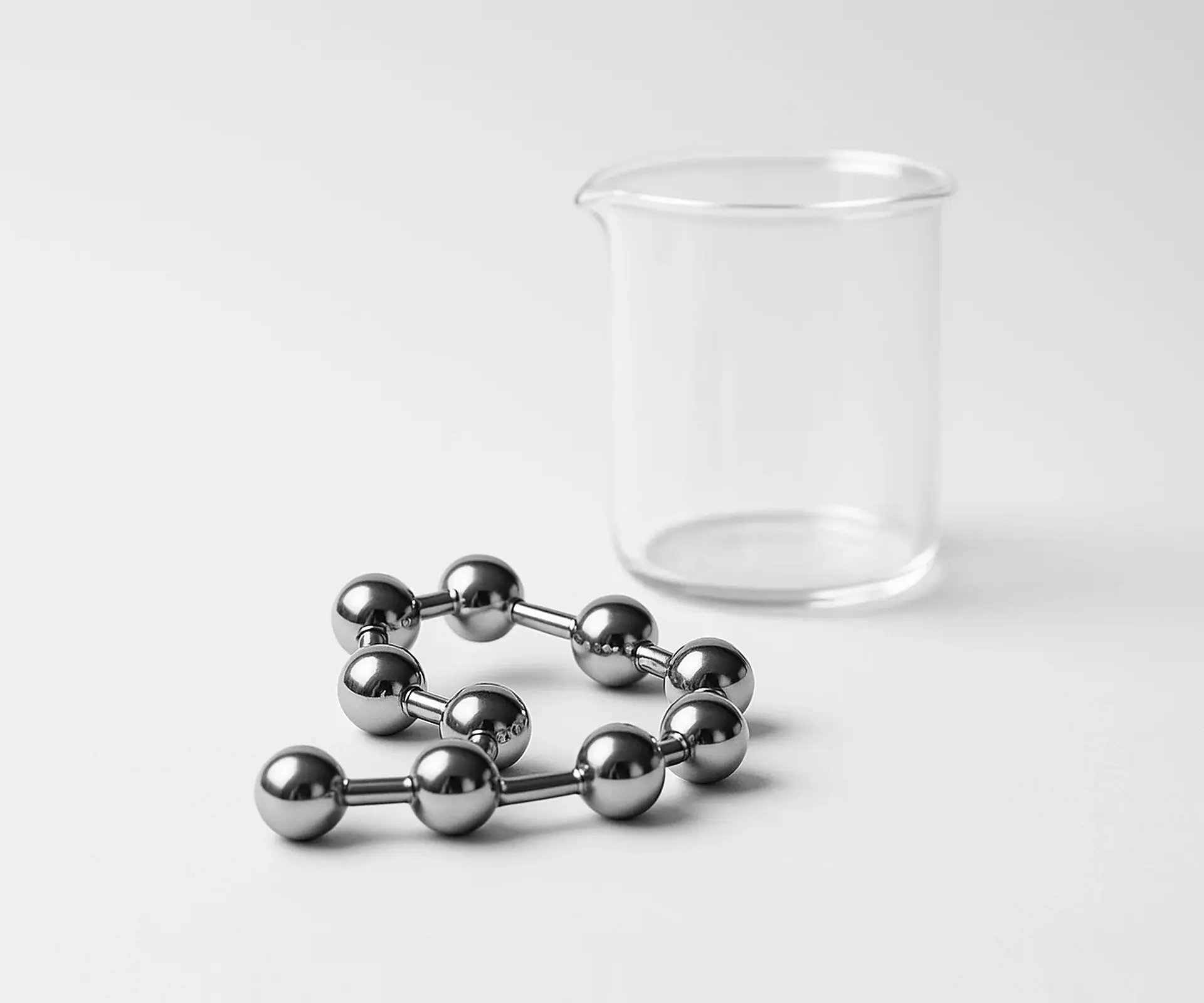
GHK-Cu is the copper(II) complex of the tripeptide glycyl-L-histidyl-L-lysine (Gly-His-Lys, or GHK). GHK is one of the smallest biologically studied peptides. Its high affinity for copper is central to how it has been researched.
GHK was first reported in 1973 by Loren Pickart and Martin Thaler. They described a tripeptide in human serum that prolonged survival of normal liver cells in culture and stimulated growth in neoplastic liver tissue (Pickart & Thaler, Nat New Biol 1973). Since then GHK and GHK-Cu have been studied in cell culture, animal models and coordination chemistry.
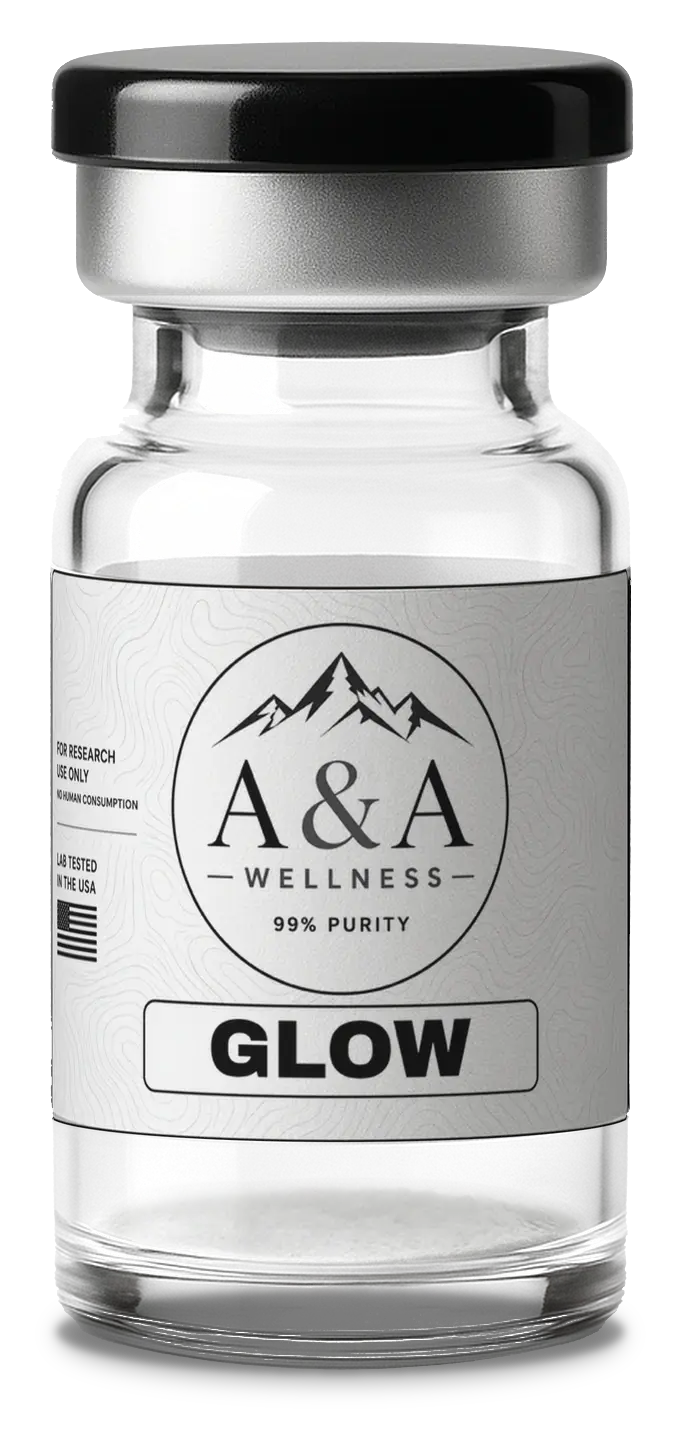
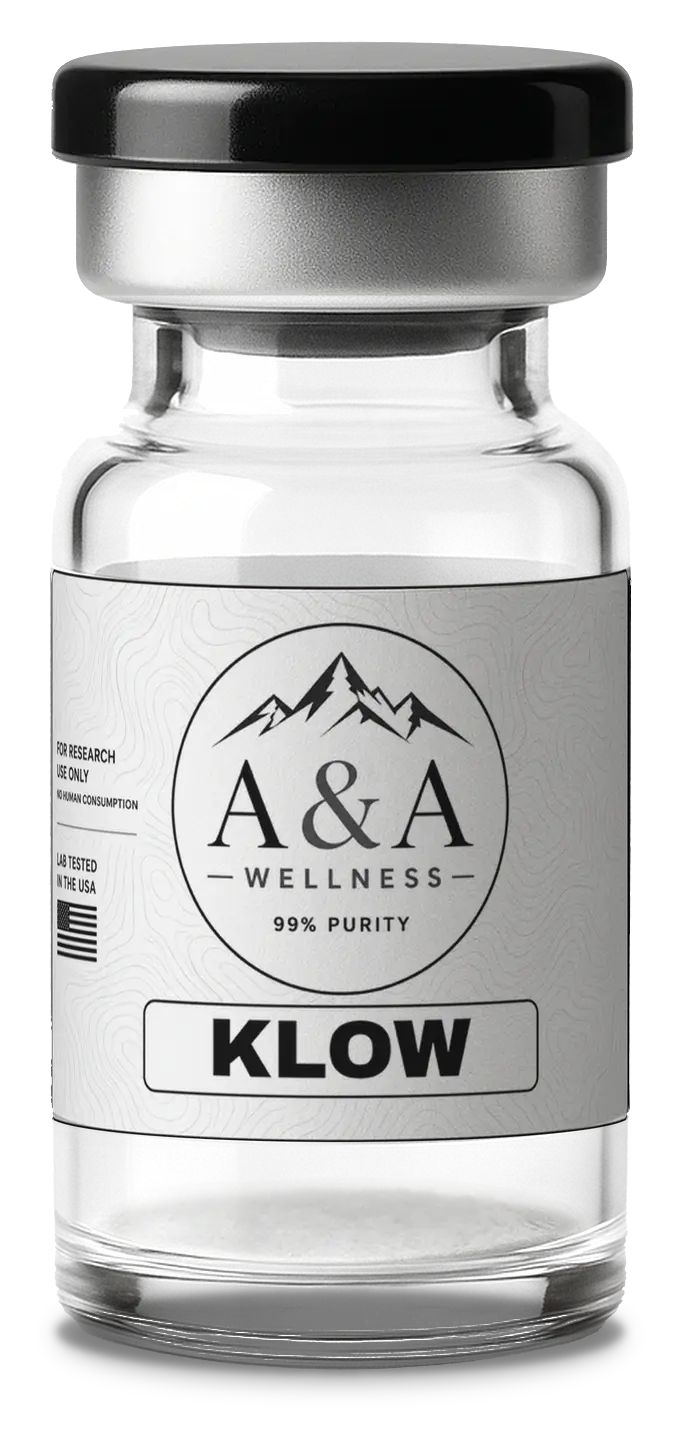
A&A Wellness supplies GHK-Cu as a component of two research blends: the GLOW Blend (GHK-Cu 50mg + BPC-157 10mg + TB-500 10mg) and the KLOW Blend (the same plus KPV 10mg). These are research materials only. They are not a drug, food, cosmetic or dietary supplement, and they are not for human or veterinary use.
Classification and structure
A copper-binding tripeptide
GHK has three residues: glycine (N-terminus), histidine and lysine (C-terminus). The N-terminal amine and the histidine imidazole make it a strong chelator of Cu(II).
Coordination chemistry
Detailed structural work was published in 2011 by Hureau and colleagues. They reported that [Cu(II)(GHK)] is dimeric in the solid state (X-ray crystallography). In solution it forms a monomeric complex with three nitrogen ligands: the N-terminal amine (NH2), a deprotonated amide (amidyl) nitrogen and the histidine imidazole. They also reported that the complex can be reduced to Cu(I), followed by copper release, which distinguishes its redox behaviour from related copper-peptide complexes (Hureau et al., Chemistry 2011).
Isothermal titration calorimetry studies report that GHK binds Cu(II) predominantly in a 1:1 ratio, with a dissociation constant on the order of 10⁻¹⁴ M (Trapaidze et al., J Biol Inorg Chem 2012). That is an extremely tight interaction.
Research material
Research-grade GHK-Cu is produced synthetically and supplied as a lyophilized powder. Copper(II) complexes are typically coloured, so blue material is expected. In A&A Wellness products GHK-Cu is present only within blends.
Mechanism as described in the literature
The mechanisms proposed for GHK-Cu come from in vitro and animal studies and from gene-expression database analyses. They are hypotheses.
Extracellular matrix synthesis in fibroblasts
In 1988 Maquart and colleagues reported that GHK-Cu stimulated collagen synthesis in cultured fibroblasts, across a range of very low concentrations. They noted that the GHK sequence occurs within the alpha 2(I) chain of type I collagen. They proposed that the tripeptide might be released by proteases where tissue is damaged (Maquart et al., FEBS Lett 1988).
Copper delivery and redox
Because GHK binds copper so tightly and the complex can undergo reduction, one line of research asks whether GHK acts partly as a copper carrier, moving Cu(II) between biological binding sites (Hureau et al., 2011; Trapaidze et al., 2012).
Gene-expression analyses
A 2018 review by Pickart and Margolina drew on gene-expression data to argue that GHK is associated with changes in many genes. It listed reported effects in the literature on matrix synthesis, blood vessel and nerve outgrowth, anti-inflammatory activity, DNA repair and proteasome activity (Pickart & Margolina, Int J Mol Sci 2018). The review’s first author is the peptide’s original discoverer, and its conclusions rest largely on preclinical and database work.
Research history and key published studies
Discovery in serum (1973)
Pickart and Thaler’s original report identified GHK as a serum factor affecting liver cells in culture (Pickart & Thaler, 1973). Its relationship with copper became a focus of later work.
Fibroblast and matrix studies (1980s)
The 1988 fibroblast collagen study shaped much of the later research direction toward extracellular matrix biology (Maquart et al., 1988).
Structural chemistry (2011–2012)
Crystallographic and calorimetric studies defined how GHK binds copper, with what stoichiometry and how tightly (Hureau et al., 2011; Trapaidze et al., 2012).
Reviews (2010s)
Reviews by Pickart and co-authors gathered cell, animal and gene-expression findings (Pickart & Margolina, 2018).
Where the evidence stands. The chemistry of GHK-Cu is well characterized. Its biological literature is mostly in vitro and animal work. FDA describes human data relevant to injectable GHK-Cu as limited (FDA).
Open questions in the literature
Peptide or copper?
Because GHK binds copper so tightly, it is hard to separate effects of the peptide from effects of the copper it carries. Some studies use GHK alone and rely on copper already present in culture media or tissue. Others use the preformed GHK-Cu complex. Comparing results across studies requires attention to which form, and what copper-to-peptide ratio, was used (Trapaidze et al., 2012).
Redox behaviour
The 2011 structural study reported that the Cu(II)–GHK complex can be reduced to Cu(I), releasing copper (Hureau et al., 2011). Whether that redox chemistry contributes to biological activity, or is mainly a consideration for handling and buffer selection, has not been resolved.
Gene-expression inference
Much of the recent case for GHK’s broad activity comes from connecting the peptide to gene-expression signatures in public databases (Pickart & Margolina, 2018). These analyses generate hypotheses. Controlled experiments are needed to confirm them.
Route-specific concerns
FDA’s position distinguishes injectable from non-injectable routes, citing aggregation and impurity concerns for the former (FDA). For laboratory work, the practical point is that material quality and characterization matter. See how to read a COA.
Regulatory status
- Not an approved drug. GHK-Cu is not FDA-approved as a drug for any use.
- Route-specific FDA categories. FDA splits GHK-Cu by route of administration.
- Injectable routes. In September 2023 FDA placed GHK-Cu for injectable routes in Category 2. It stated that compounded injectable drugs containing GHK-Cu “may pose risk for immunogenicity due to the potential for aggregation and peptide-related impurities,” and that “there are limited data in humans to inform safety-related considerations” (FDA). That page now lists the injectable nomination as withdrawn.
- Non-injectable routes. GHK-Cu for non-injectable routes is in Category 1 (under evaluation). FDA’s May 14, 2026 update explains that it was removed on April 22, 2026 after nominations were withdrawn. It was then restored after a nominator clarified on May 5, 2026 that it had withdrawn only the injectable route. FDA says it intends to consult its Pharmacy Compounding Advisory Committee before the end of February 2027 on possible inclusion of GHK-Cu on the 503A bulks list (FDA 503A categories).
- A&A Wellness material. Our GHK-Cu-containing blends are research materials only, not for human or veterinary use and not cosmetic ingredients.
See our regulatory overview. It is general information, not legal advice.
Handling and storage in the lab
General conventions; follow your SOPs.
- Sealed, cold, dark and dry. Store lyophilized blend vials protected from moisture and light. Freezer storage is common for long-term holding.
- Metal-complex considerations. GHK-Cu is a metal complex. Buffers containing strong chelators (such as EDTA) or reducing agents can compete for or reduce the copper. Check compatibility before choosing a diluent or assay buffer.
- Equilibrate before opening to limit condensation, and use aseptic technique when preparing solutions.
- Aliquot and label. Avoid repeated freeze-thaw cycles. Record contents, concentration and date.
See the peptide storage guide and reconstitution guide.
Research-use notice
All A&A Wellness products are for research use only. They are not for human or veterinary use and are not a drug, food, cosmetic or dietary supplement. This page summarizes published research for education. It makes no claim that GHK-Cu has any established effect in people and does not suggest that anyone use it. Please read our Research Use Policy before ordering.
Related resources
- Products: GLOW Blend, KLOW Blend
- Related compounds: BPC-157, TB-500, KPV
- Background: What are research peptides?
- Category: Research Blends
- Quality: Our quality standards
Sources
- Pickart L, Thaler MM. Tripeptide in human serum which prolongs survival of normal liver cells and stimulates growth in neoplastic liver. Nat New Biol. 1973;243(124):85-87.
- Maquart FX, et al. Stimulation of collagen synthesis in fibroblast cultures by the tripeptide-copper complex glycyl-L-histidyl-L-lysine-Cu2+. FEBS Lett. 1988;238(2):343-346.
- Hureau C, et al. X-ray and solution structures of Cu(II) GHK and Cu(II) DAHK complexes: influence on their redox properties. Chemistry. 2011;17(36):10151-10160.
- Trapaidze A, et al. Thermodynamic study of Cu2+ binding to the DAHK and GHK peptides by isothermal titration calorimetry (ITC) with the weaker competitor glycine. J Biol Inorg Chem. 2012;17(1):37-47.
- Pickart L, Margolina A. Regenerative and Protective Actions of the GHK-Cu Peptide in the Light of the New Gene Data. Int J Mol Sci. 2018;19(7):1987.
- U.S. FDA. Bulk Drug Substances Nominated for Use in Compounding Under Section 503A of the FD&C Act (updated May 14, 2026).
- U.S. FDA. Certain Bulk Drug Substances for Use in Compounding that May Present Significant Safety Risks.