What TB-500 is
TB-500 is a synthetic research peptide related to thymosin beta-4 (Tβ4), a small protein found in many cell types. The name is widely used, but it is often applied loosely. That makes precision important.
Analytical chemists who examined a product sold as TB-500 identified its active content as the N-terminal acetylated 17–23 fragment of human thymosin beta-4, with the sequence Ac-LKKTETQ (Esposito et al., Drug Test Anal 2012). A separate doping-control study described TB-500 as “a synthetic version of an active region of thymosin β4.” It identified the key ingredient as the peptide LKKTETQ “with artificial acetylation of the N-terminus” (Ho et al., J Chromatogr A 2012).
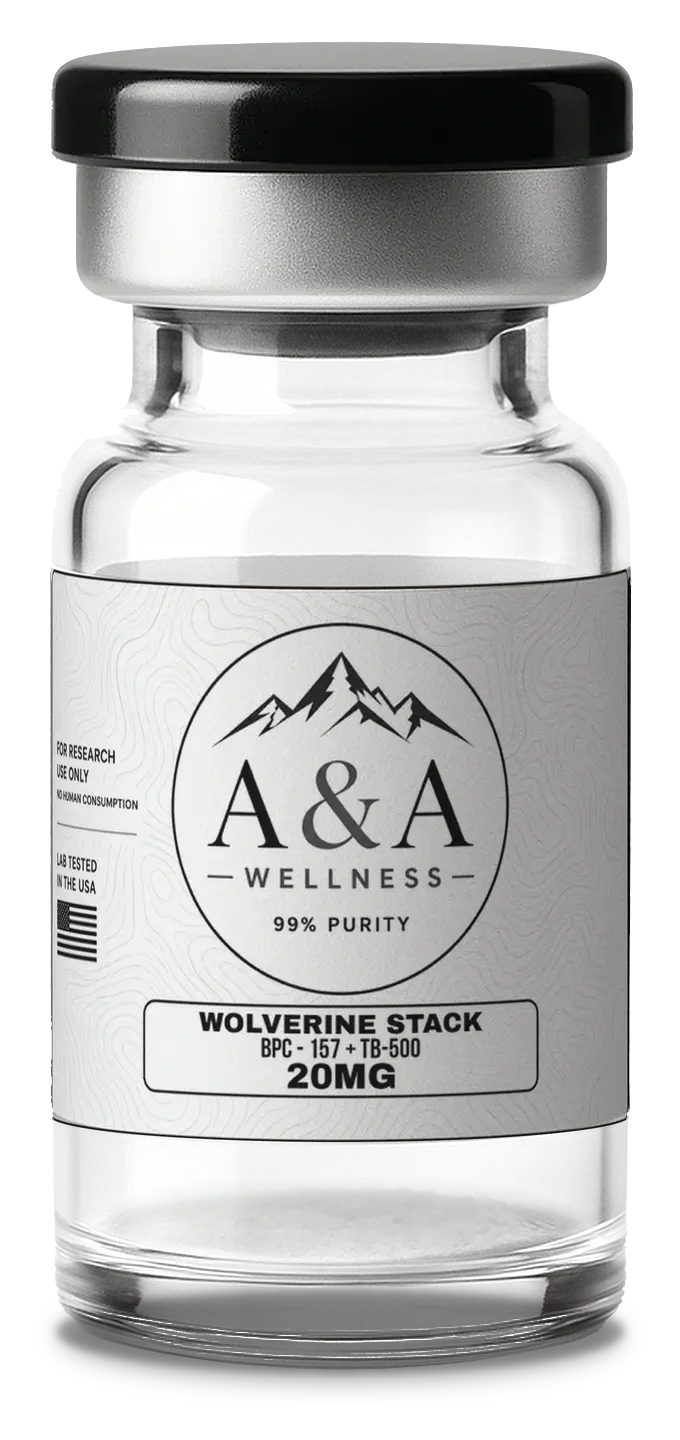
A&A Wellness supplies TB-500 as a component of its research blends: the Wolverine Blend (BPC-157 + TB-500), the GLOW Blend and the KLOW Blend. These are research materials only. They are not a drug, food, cosmetic or dietary supplement, and they are not for human or veterinary use.
Classification and structure
Thymosin beta-4: the parent protein
Thymosin beta-4 is a naturally occurring peptide of 43 amino acids. In 1991, Safer and colleagues showed that Tβ4 is identical to “Fx,” a peptide that sequesters actin. They reported that it forms a 1:1 complex with actin monomers and inhibits their polymerization. Given its wide distribution and high intracellular concentration, they concluded it likely plays a significant role in regulating actin polymerization in many cell types (Safer et al., J Biol Chem 1991).
The 17–23 fragment
The segment LKKTETQ (Leu-Lys-Lys-Thr-Glu-Thr-Gln) is residues 17 to 23 of Tβ4. Ho and colleagues describe it as “the active site within the protein thymosin β4” (Ho et al., 2012). In TB-500 this seven-residue segment carries an N-terminal acetyl group, which native Tβ4 does not have at that position.
What is and isn’t established
- Established. Analytical studies have identified Ac-LKKTETQ in material sold as TB-500 and have developed mass-spectrometry methods to detect it and its metabolites (Esposito et al., 2012; Ho et al., 2012).
- Not established. Most of the biological research described below was done with full-length thymosin beta-4, not the acetylated fragment. Findings for the full protein cannot simply be assumed to apply to TB-500.
- Naming varies. FDA refers to this material as “thymosin beta-4, fragment (LKKTETQ/TB-500).” Some commercial products labeled “TB-500” may not match the fragment. Batch identity should be confirmed by analytical documentation (see our guide to HPLC and mass spectrometry).
Mechanism as described in the literature
Actin sequestration
Tβ4’s best-characterized molecular role is binding monomeric (G-) actin and controlling the pool available for filament assembly (Safer et al., 1991). The actin cytoskeleton drives cell shape and movement, so this role connects Tβ4 to research on cell migration.
Cell migration and survival signalling
A 2004 Nature paper by Bock-Marquette and colleagues reported that Tβ4 promoted migration of myocardial and endothelial cells in the embryonic mouse heart. It also enhanced cardiomyocyte survival through integrin-linked kinase (ILK) and Akt signalling. In a mouse cardiac injury model, the authors reported improved early myocyte survival and cardiac function measures (Bock-Marquette et al., Nature 2004).
These are findings for the full-length protein in mice. They describe research mechanisms, not established effects of TB-500.
Research history and key published studies
Thymosins and actin (to 1991)
Tβ4 was first studied as part of a group of thymus-derived peptides called thymosins. Its identification as a major actin-sequestering molecule in 1991 shifted attention to cytoskeletal biology (Safer et al., 1991).
Tissue-repair models (2000s)
The 2000s brought a wave of animal and cell studies on Tβ4 in cardiac, dermal, corneal and neural injury models, including the 2004 cardiac study above. A 2012 review by Goldstein and colleagues summarized this work. It stated that Tβ4 “binds to actin and promotes cell migration,” and described the preclinical base behind ongoing and planned clinical trials of Tβ4 for dermal, corneal and cardiac indications (Goldstein et al., Expert Opin Biol Ther 2012). Those trials concerned thymosin beta-4 itself, not TB-500.
Anti-doping analytics (2012 onward)
A parallel literature emerged from anti-doping laboratories. Concern that TB-500 might be misused in human and equine sport led to synthesis of reference material and development of LC-MS detection methods for the fragment and its metabolites in urine and plasma (Esposito et al., 2012; Ho et al., 2012).
Where the evidence stands. Research specific to the acetylated LKKTETQ fragment is mostly analytical: identification, synthesis and detection. The mechanistic and tissue-model literature is largely about full-length Tβ4 in cells and animals. We are not aware of published, completed, controlled clinical trials of TB-500.
Open questions in the literature
Fragment versus protein
The central question is how far findings for full-length thymosin beta-4 carry over to the acetylated LKKTETQ fragment. The 17–23 region is described as the actin-binding site (Ho et al., 2012). But a seven-residue fragment differs from a 43-residue protein in folding, binding partners and metabolic stability. Direct, peer-reviewed comparisons of the two in the same models are scarce.
Metabolism
Anti-doping research has focused on how TB-500 is broken down, so that it can be detected. Those studies established analytical targets for the fragment and its metabolites in urine and plasma (Ho et al., 2012). They were not designed to explain biological activity, and it remains open whether the fragment or a metabolite accounts for any effect.
Product identity
“TB-500” is a trade name, not a pharmacopeial one. Analytical studies found Ac-LKKTETQ in the material they examined (Esposito et al., 2012), but labeling across the market is inconsistent. For research use, batch-specific mass-spectrometry confirmation of the expected sequence and mass is the most direct safeguard. See how to read a COA.
Immunogenicity and aggregation
FDA’s safety summary cites a potential for aggregation and peptide-related impurities (FDA). Both are material-quality questions that apply to any laboratory study using the fragment.
Regulatory status
- Not an approved drug. TB-500 is not FDA-approved for any use.
- FDA Category 2 (2023) and withdrawal. In September 2023 FDA added “Thymosin Beta-4, Fragment (LKKTETQ)” to Category 2 of its 503A bulk drug substance categories. FDA’s safety-risk page states that compounded drugs containing it “may pose risk for immunogenicity for certain routes of administration due to the potential for aggregation as well as peptide-related impurities.” The page adds that FDA identified no human exposure data. As of the page’s April 22, 2026 update, the nomination is listed as withdrawn (FDA).
- July 2026 advisory committee. At its July 23–24, 2026 meeting, FDA’s Pharmacy Compounding Advisory Committee voted to recommend adding TB-500 to the 503A bulks list. The vote is non-binding, and at the time of writing FDA had not issued a final decision (Mintz, July 2026).
- WADA. The 2026 Prohibited List includes “Thymosin-β4 and its derivatives e.g. TB-500” in class S2 (peptide hormones, growth factors, related substances and mimetics) (WADA 2026 List).
- A&A Wellness material. Our blends containing TB-500 are for laboratory research only.
See our regulatory overview. It is general information, not legal advice.
Handling and storage in the lab
General conventions only. Follow your SOPs.
- Lyophilized storage. Keep sealed vials cold, dry and protected from light. Freezer storage is common for long-term holding.
- Equilibrate before opening. Let the sealed vial reach room temperature to avoid condensation.
- Blend awareness. TB-500 is supplied within multi-peptide blends, so handling should suit the most sensitive component in the vial.
- Aliquot and label. Prepare solutions aseptically, divide them into single-use aliquots, record concentration and date, and avoid repeated freeze-thaw cycles.
See the peptide storage guide and reconstitution guide.
Research-use notice
All A&A Wellness products are for research use only. They are not for human or veterinary use and are not a drug, food, cosmetic or dietary supplement. This page describes published analytical, cell and animal research. It does not suggest that TB-500 has any established effect in people or that anyone should use it. Please read our Research Use Policy before ordering.
Related resources
- Products: Wolverine Blend, GLOW Blend, KLOW Blend
- Related compounds: BPC-157, GHK-Cu
- Comparison guide: BPC-157 vs TB-500
- Background: What are research peptides?
- Category: Research Blends
- Quality: Our quality standards
Sources
- Safer D, Elzinga M, Nachmias VT. Thymosin beta 4 and Fx, an actin-sequestering peptide, are indistinguishable. J Biol Chem. 1991.
- Bock-Marquette I, et al. Thymosin beta4 activates integrin-linked kinase and promotes cardiac cell migration, survival and cardiac repair. Nature. 2004.
- Goldstein AL, et al. Thymosin β4: a multi-functional regenerative peptide. Basic properties and clinical applications. Expert Opin Biol Ther. 2012.
- Esposito S, et al. Synthesis and characterization of the N-terminal acetylated 17-23 fragment of thymosin beta 4 identified in TB-500, a product suspected to possess doping potential. Drug Test Anal. 2012.
- Ho EN, et al. Doping control analysis of TB-500, a synthetic version of an active region of thymosin β4, in equine urine and plasma by liquid chromatography-mass spectrometry. J Chromatogr A. 2012.
- U.S. FDA. Certain Bulk Drug Substances for Use in Compounding that May Present Significant Safety Risks.
- World Anti-Doping Agency. 2026 Prohibited List (International Standard).
- Mintz. FDA's Advisory Committee Votes on Peptides (Viewpoint, July 29, 2026).