What BPC-157 is
BPC-157 is a synthetic pentadecapeptide, a peptide of 15 amino acids. “BPC” stands for body protection compound. Researchers describe BPC-157 as a partial sequence of a larger protein that was “discovered in and isolated from human gastric juice” (Chang et al., J Appl Physiol 2011).
BPC-157 is one of the most studied peptides in preclinical research, especially in rodent models of gastrointestinal and musculoskeletal injury. It is also one of the least studied in people. That gap between an extensive animal literature and very limited human data is the key context for everything below.
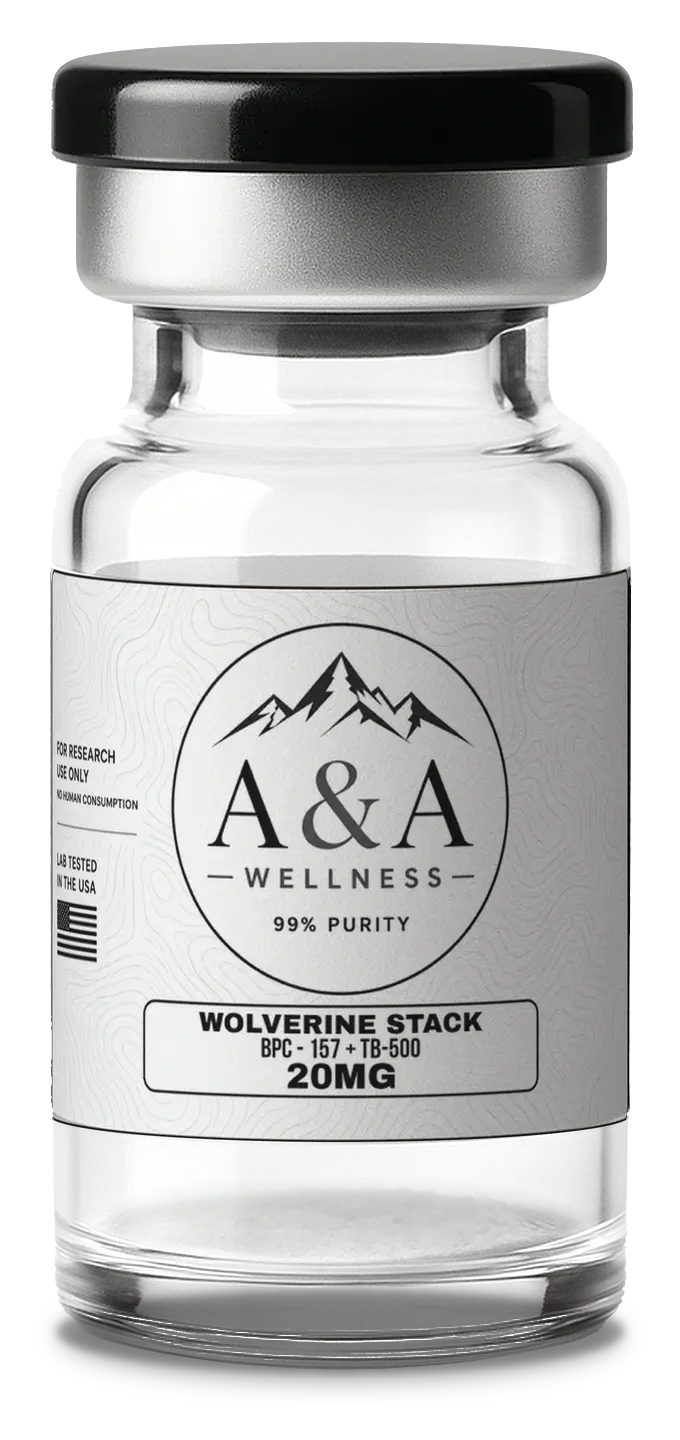
A&A Wellness supplies BPC-157 as a component of its research blends: the Wolverine Blend (BPC-157 + TB-500), the GLOW Blend and the KLOW Blend. All are research materials for laboratory use. They are not a drug, food, cosmetic or dietary supplement, and they are not for human or veterinary use.
Classification and structure
A gastric-derived partial sequence
The sequence commonly reported for BPC-157 is Gly-Glu-Pro-Pro-Pro-Gly-Lys-Pro-Ala-Asp-Asp-Ala-Gly-Leu-Val (GEPPPGKPADDAGLV). Much of the literature calls it a “stable gastric pentadecapeptide,” reflecting its reported stability in gastric conditions.
What is and isn’t established. The name and origin story come mainly from one research group that has produced much of the BPC-157 literature. The parent protein is not well characterized in independent literature. At FDA’s July 2026 advisory committee meeting, agency staff described BPC-157 as “not well-characterized” as a drug substance (RAPS, July 2026).
Research material
Research-grade BPC-157 is made by solid-phase peptide synthesis and supplied lyophilized. It is sold as free base or as a salt, such as the acetate. In A&A Wellness products it appears only in combination with other peptides. The per-compound split within the Wolverine Blend is not specified on this page. See the product page for published specifications.
Mechanism as described in the literature
No single mechanism is established. The pathways below come from cell culture and animal studies.
Angiogenic signalling (VEGFR2)
In a 2017 study in rats and cultured human vascular endothelial cells, Hsieh and colleagues reported that BPC-157 increased vessel density both in vivo and in vitro. They reported that it upregulated VEGFR2 (a receptor for vascular endothelial growth factor) and promoted its internalization, alongside activation of the VEGFR2–Akt–eNOS pathway. BPC-157 increased VEGFR2 expression without raising VEGF-A itself, which the authors noted as distinctive (Hsieh et al., J Mol Med 2017).
Fibroblast migration (FAK–paxillin)
A 2011 in vitro study used cultured rat Achilles tendon fibroblasts. Chang and colleagues reported that BPC-157 increased outgrowth from tendon explants, cell survival under oxidative stress and fibroblast migration. It also increased phosphorylation of FAK and paxillin, proteins involved in cell adhesion and migration (Chang et al., 2011).
Nitric oxide and other pathways
Reviews also describe interactions with the nitric oxide system and with growth hormone receptor expression. A 2025 systematic review summarized the preclinical data as showing effects on “growth hormone receptor expression and several pathways involved in cell growth and angiogenesis,” along with reduced inflammatory cytokines in those models (Vasireddi et al., HSS J 2025).
Research history and key published studies
Three decades of animal research
BPC-157 research dates to the early 1990s. The 2025 systematic review covered studies from 1993 to 2024 (Vasireddi et al., 2025). Most of the work uses rats and focuses on gastrointestinal lesions, tendon, ligament, muscle and bone models, and vascular models.
A 2019 critical review in Cell and Tissue Research noted that studies had reported consistently positive outcomes across injury models. It also cautioned that “the majority of studies have been performed on small rodent models and the efficacy of BPC 157 is yet to be confirmed in humans” (Gwyer et al., 2019).
Systematic and narrative reviews (2025)
- Vasireddi et al., 2025. This systematic review of the orthopaedic literature found 36 studies: 35 preclinical and 1 clinical. The authors noted a reported plasma half-life under 30 minutes. They warned that “adverse effects are possible due to unregulated manufacturing, contamination, or unknown clinical safety,” and called for human clinical trials (Vasireddi et al., 2025).
- McGuire et al., 2025. This narrative review described the preclinical evidence as robust but human data as “extremely limited,” with only three small pilot studies in people. The authors concluded that “BPC-157 should be considered investigational” until well-designed clinical trials are conducted (McGuire et al., 2025).
A preclinical evidence base. Across these reviews the picture is the same. There is a large rodent literature concentrated in a few research groups, a handful of small uncontrolled human reports, and no completed large randomized controlled trial.
Open questions in the literature
Characterization
Regulators have pointed to uncertainty about what “BPC-157” is as a drug substance. FDA’s safety summary refers to complexities with peptide-related impurities and characterization of the active ingredient (FDA). For researchers, this makes independent identity and purity data for every batch essential. See how to read a COA.
Short half-life, long-lasting reported effects
The 2025 systematic review notes a reported plasma half-life under 30 minutes (Vasireddi et al., 2025). Animal studies, meanwhile, report effects lasting much longer. How these two observations fit together is unresolved and is a recurring theme in recent reviews.
Concentration of authorship
A large share of the BPC-157 literature comes from a small number of research groups. Independent replication with characterized material and pre-registered designs would strengthen, or challenge, the preclinical findings.
Safety data
Reviewers note that few studies report adverse effects. They also stress that the absence of reported harm in small animal studies is not evidence of safety, and that unregulated manufacturing adds uncertainty (Vasireddi et al., 2025; McGuire et al., 2025).
Regulatory status
- Not an approved drug. BPC-157 is not FDA-approved for any use and is not the active ingredient in any FDA-approved medicine.
- FDA Category 2 (2023) and withdrawal. In September 2023 FDA added BPC-157 to Category 2 of its 503A bulk drug substance categories, substances raising significant safety concerns. FDA’s safety-risk page states that compounded drugs containing BPC-157 “may pose risk for immunogenicity for certain routes of administration and may have complexities with regard to peptide-related impurities and active pharmaceutical ingredient (API) characterization.” As of that page’s April 22, 2026 update, the BPC-157 nomination is listed as withdrawn (FDA).
- July 2026 advisory committee vote. On July 23, 2026, FDA’s Pharmacy Compounding Advisory Committee voted to recommend adding BPC-157 to the 503A bulks list, evaluated for ulcerative colitis. FDA staff had recommended against it. The vote is non-binding, and at the time of writing FDA had not issued a final decision (Mintz, July 2026). A future listing would concern patient-specific pharmacy compounding only. It would not make BPC-157 an approved drug.
- WADA. The 2026 World Anti-Doping Agency Prohibited List names BPC-157 in class S0, Non-Approved Substances, which is prohibited at all times (WADA 2026 List).
- A&A Wellness material. Our blends containing BPC-157 are research materials only, not for human or veterinary use.
See our regulatory overview for broader context. It is general information, not legal advice.
Handling and storage in the lab
General conventions for lyophilized peptides and blends. Follow your laboratory’s SOPs.
- Store sealed, cold and dry. Keep unopened lyophilized vials protected from moisture and light. Freezer storage is common for long-term holding.
- Equilibrate first. Let vials reach room temperature before opening to prevent condensation.
- Remember it’s a blend. A blend vial holds several peptides with different properties. Handling decisions, such as diluent choice or solution storage time, should account for the most sensitive component.
- Aseptic technique and aliquots. Prepare solutions with clean technique, label aliquots with contents, concentration and date, and avoid repeated freeze-thaw cycles.
See our peptide storage guide and reconstitution guide.
Research-use notice
All A&A Wellness products are for research use only. They are not for human or veterinary use and are not a drug, food, cosmetic or dietary supplement. This page summarizes published research, most of it in animals and cell culture. It does not suggest that BPC-157 has any established effect in people or that anyone should use it. Please read our Research Use Policy before ordering.
Related resources
- Products: Wolverine Blend, GLOW Blend, KLOW Blend
- Related compounds: TB-500, GHK-Cu, KPV
- Comparison guide: BPC-157 vs TB-500
- Background: What are research peptides?
- Category: Research Blends
- Quality: Our quality standards
Sources
- Chang CH, et al. The promoting effect of pentadecapeptide BPC 157 on tendon healing involves tendon outgrowth, cell survival, and cell migration. J Appl Physiol. 2011;110(3):774-780.
- Hsieh MJ, et al. Therapeutic potential of pro-angiogenic BPC157 is associated with VEGFR2 activation and up-regulation. J Mol Med (Berl). 2017;95(3):323-333.
- Gwyer D, Wragg NM, Wilson SL. Gastric pentadecapeptide body protection compound BPC 157 and its role in accelerating musculoskeletal soft tissue healing. Cell Tissue Res. 2019;377(2):153-159.
- Vasireddi N, et al. Emerging Use of BPC-157 in Orthopaedic Sports Medicine: A Systematic Review. HSS J. 2025;21(4):485-495.
- McGuire FP, et al. Regeneration or Risk? A Narrative Review of BPC-157 for Musculoskeletal Healing. Curr Rev Musculoskelet Med. 2025;18(12):611-619.
- U.S. FDA. Certain Bulk Drug Substances for Use in Compounding that May Present Significant Safety Risks.
- World Anti-Doping Agency. 2026 Prohibited List (International Standard).
- Mintz. FDA's Advisory Committee Votes on Peptides (Viewpoint, July 29, 2026).