What KPV is
KPV is a tripeptide, a chain of three amino acids: lysine–proline–valine (Lys-Pro-Val). It is the C-terminal sequence of alpha-melanocyte-stimulating hormone (α-MSH), a 13-amino-acid peptide produced from the precursor protein pro-opiomelanocortin (POMC).
Research interest in KPV comes from studies of α-MSH in inflammation. Investigators asked whether a much smaller fragment could reproduce some of the parent peptide’s reported anti-inflammatory activity in experimental systems, without its effects on pigmentation (Brzoska et al., Endocr Rev 2008).
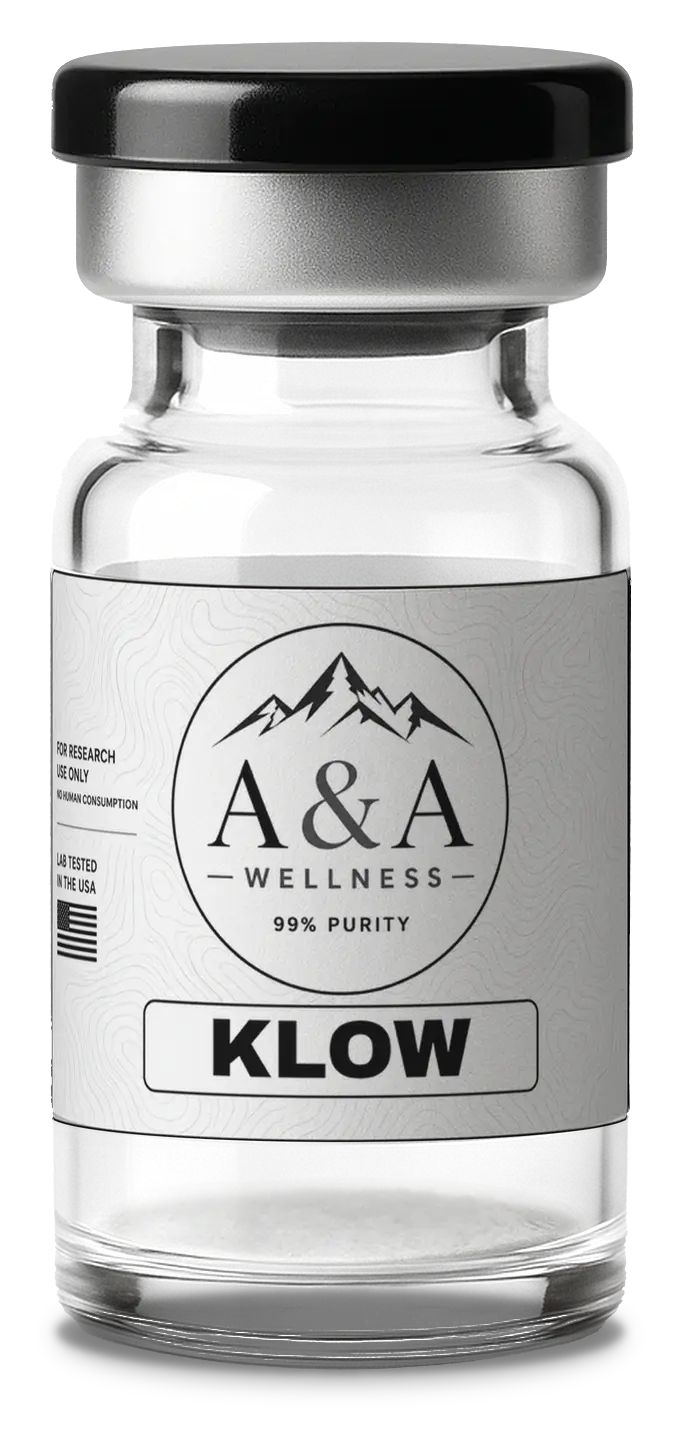
A&A Wellness supplies KPV as one of four components in the KLOW Blend (GHK-Cu 50mg + BPC-157 10mg + TB-500 10mg + KPV 10mg). It is a research material only. It is not a drug, food, cosmetic or dietary supplement, and it is not for human or veterinary use.
Classification and structure
A melanocortin-derived fragment
α-MSH belongs to the melanocortin family of peptides, which act on melanocortin receptors (MC1R to MC5R). KPV corresponds to residues 11–13 of α-MSH. Because it is so small, KPV is often called a “minimal” fragment in reviews of α-MSH-related peptides (Brzoska et al., 2008).
What is and isn’t established
- Reported in reviews. The 2008 Endocrine Reviews article describes KPV as retaining anti-inflammatory activity in experimental models while lacking pigmentary action (Brzoska et al., 2008).
- Receptor question open. KPV’s relationship to melanocortin receptors is not settled. In a 2008 mouse study, KPV’s effects were still seen in mice with non-functional MC1R. The authors interpreted this as evidence of mechanisms “independent of MC1R signaling” (Kannengiesser et al., Inflamm Bowel Dis 2008).
Research material
Research-grade KPV is produced synthetically. In A&A Wellness products it appears only within the lyophilized KLOW Blend.
Mechanism as described in the literature
The mechanisms below come from cell culture and mouse studies.
NF-κB and MAP kinase signalling
Dalmasso and colleagues, writing in Gastroenterology in 2008, reported that nanomolar concentrations of KPV inhibited activation of the NF-κB and MAP kinase inflammatory signalling pathways in intestinal epithelial and immune cells (Dalmasso et al., Gastroenterology 2008). NF-κB is a transcription factor that controls many pro-inflammatory genes. Brzoska and colleagues’ review likewise lists NF-κB activation among the pathways α-MSH and its tripeptides affect in experimental systems (Brzoska et al., 2008).
Uptake through PepT1
The same 2008 study reported that KPV enters cells through PepT1, a transporter for di- and tripeptides expressed in intestinal epithelium and, the authors reported, in immune cells during inflammation. This transporter-mediated uptake offered one explanation for how a peptide this small could act inside cells without relying on a surface receptor (Dalmasso et al., 2008).
Research history and key published studies
α-MSH and its C-terminal tripeptides
Interest in KPV grew out of decades of α-MSH research. The 2008 Endocrine Reviews synthesis covered the biochemistry of α-MSH and related tripeptides, their effects in cell and animal models, and the rationale for studying KPV rather than the full hormone (Brzoska et al., 2008).
Mouse colitis models (2008)
Two 2008 papers studied KPV in chemically induced mouse colitis models, a standard experimental approach in inflammation research:
- Dalmasso et al. reported that KPV reduced the incidence and severity of inflammation in DSS- and TNBS-induced colitis in mice, and linked this to PepT1-mediated uptake (Dalmasso et al., 2008).
- Kannengiesser et al. reported earlier recovery and reduced inflammatory infiltrates and myeloperoxidase activity in DSS colitis. The effects persisted in MC1R-deficient mice (Kannengiesser et al., 2008).
Formulation research (2010)
In 2010 Laroui and colleagues described nanoparticles encapsulated in a polysaccharide hydrogel designed to deliver KPV to colonic tissue in mice. They reported that with this system, KPV could be delivered at a concentration “12,000-fold lower than that of KPV in free solution, but with similar therapeutic efficacy” in the DSS model (Laroui et al., Gastroenterology 2010). The paper is often cited as an example of peptide drug-delivery research rather than for KPV alone.
A preclinical evidence base. The KPV literature consists of cell studies and mouse models. FDA states that it “has not identified any human exposure data on drug products containing KPV administered via any route of administration” (FDA).
Open questions in the literature
Receptor or transporter?
The two 2008 mouse studies point in slightly different directions. One emphasizes uptake through the PepT1 transporter and effects inside the cell (Dalmasso et al., 2008). The other shows activity persisting without functional MC1R (Kannengiesser et al., 2008). Neither rules out a contribution from other melanocortin receptors. How receptor-dependent and receptor-independent mechanisms are balanced remains open.
Model dependence
Most in vivo KPV data come from chemically induced colitis models in mice (DSS and TNBS). These are widely used, but each captures only part of the biology of inflammation. Results from them are not directly generalizable to other tissues or species.
Stability of a very small peptide
Tripeptides are rapidly handled by peptidases and transporters. The 2010 nanoparticle work was motivated partly by the challenge of delivering KPV intact to its target tissue in experimental models (Laroui et al., 2010). Stability is also a practical consideration for handling in the lab.
Human data
FDA’s summary is unambiguous: it has identified no human exposure data on drug products containing KPV (FDA). The advisory committee vote in July 2026 did not change that evidentiary picture.
Regulatory status
- Not an approved drug. KPV is not FDA-approved for any use.
- FDA Category 2 (2023) and withdrawal. In its September 2023 update FDA added KPV to Category 2 of the 503A bulk drug substance categories. It cited the absence of human exposure data and a lack of information on potential safety issues. As of the FDA safety-risk page’s April 22, 2026 update, the KPV nomination is listed as withdrawn (FDA).
- July 2026 advisory committee. At its July 23–24, 2026 meeting, FDA’s Pharmacy Compounding Advisory Committee voted to recommend adding KPV to the 503A bulks list. Advisory votes are not agency actions, and at the time of writing FDA had not made a final decision (Mintz, July 2026). A future listing would concern pharmacy compounding only and would not make KPV an approved drug.
- A&A Wellness material. The KLOW Blend is a research material only, not for human or veterinary use.
See our regulatory overview. It is general information, not legal advice.
Handling and storage in the lab
General conventions; follow your SOPs.
- Lyophilized storage. Store sealed vials cold, dry and away from light. Freezer storage is common for long-term holding.
- Equilibrate before opening so condensation does not form on the powder.
- Blend awareness. KPV is supplied in a four-component blend that includes a copper complex (GHK-Cu). Choose diluents and buffers compatible with every component. For example, avoid strong chelating agents unless your protocol requires them.
- Aseptic technique and aliquots. Prepare solutions cleanly, split them into labelled single-use aliquots and avoid repeated freeze-thaw cycles.
Our peptide storage guide and reconstitution guide cover these practices.
Research-use notice
All A&A Wellness products are for research use only. They are not for human or veterinary use and are not a drug, food, cosmetic or dietary supplement. This page summarizes preclinical research for education. It does not suggest that KPV has any established effect in people or that anyone should use it. Please read our Research Use Policy before ordering.
Related resources
- Product: KLOW Blend
- Related compounds: GHK-Cu, BPC-157, TB-500
- Background: What are research peptides?
- Category: Research Blends
- Quality: Our quality standards
Sources
- Brzoska T, et al. Alpha-melanocyte-stimulating hormone and related tripeptides: biochemistry, antiinflammatory and protective effects in vitro and in vivo, and future perspectives for the treatment of immune-mediated inflammatory diseases. Endocr Rev. 2008;29(5):581-602.
- Dalmasso G, et al. PepT1-mediated tripeptide KPV uptake reduces intestinal inflammation. Gastroenterology. 2008;134(1):166-178.
- Kannengiesser K, et al. Melanocortin-derived tripeptide KPV has anti-inflammatory potential in murine models of inflammatory bowel disease. Inflamm Bowel Dis. 2008;14(3):324-331.
- Laroui H, et al. Drug-loaded nanoparticles targeted to the colon with polysaccharide hydrogel reduce colitis in a mouse model. Gastroenterology. 2010;138(3):843-853.
- U.S. FDA. Certain Bulk Drug Substances for Use in Compounding that May Present Significant Safety Risks.
- Mintz. FDA's Advisory Committee Votes on Peptides (Viewpoint, July 29, 2026).