What ipamorelin is
Ipamorelin is a synthetic pentapeptide, a peptide of five amino acids, that stimulates growth hormone (GH) release by activating the growth hormone secretagogue receptor (GHS-R1a). It was developed at Novo Nordisk and first fully characterized in a 1998 paper titled “Ipamorelin, the first selective growth hormone secretagogue” (Raun et al., Eur J Endocrinol 1998).
It uses the ghrelin receptor. Because GHS-R1a is the receptor for the endogenous hormone ghrelin, ipamorelin is often called a ghrelin mimetic or ghrelin-receptor agonist. Its route to GH release is different from that of GHRH analogs such as CJC-1295 and tesamorelin.
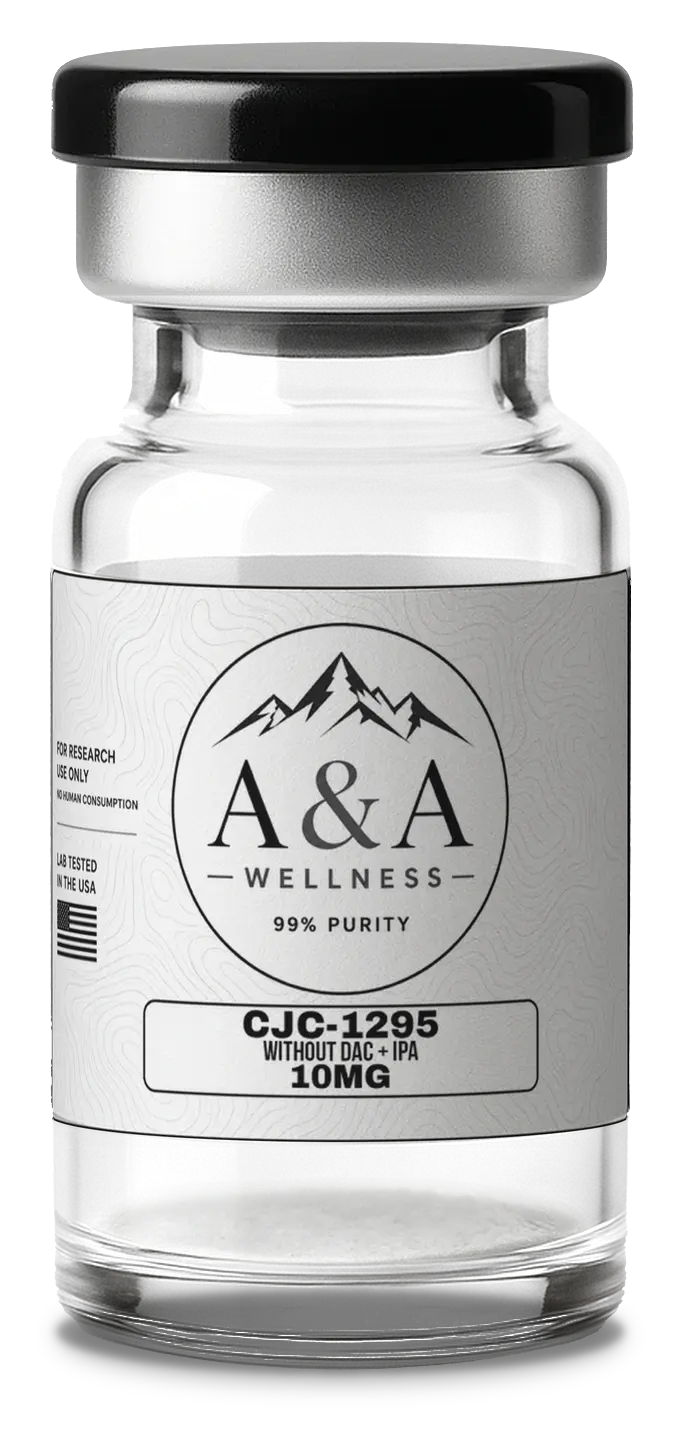
A&A Wellness supplies ipamorelin as part of CJC-1295 Without DAC + Ipamorelin, a combined research material for laboratory use only. It is not a drug, food, cosmetic or supplement and is not for human or veterinary use.
Classification and structure
A growth hormone-releasing peptide (GHRP)
Ipamorelin belongs to the growth hormone-releasing peptides (GHRPs). This family of small synthetic peptides was developed from the late 1970s onward, before anyone knew which receptor they acted on. Earlier members include GHRP-6 and GHRP-2. The Novo Nordisk chemistry programme that produced ipamorelin worked from compounds lacking the central Ala-Trp dipeptide of GHRP-1 (Raun et al., 1998).
Sequence
The published sequence is Aib-His-D-2-Nal-D-Phe-Lys-NH2 (Raun et al., 1998). Three features stand out:
- Aib (α-aminoisobutyric acid) is a non-proteinogenic amino acid.
- D-2-Nal (D-2-naphthylalanine) and D-Phe are D-configured aromatic residues.
- A C-terminal amide completes the sequence.
Why the unusual residues matter. These non-standard residues help the molecule resist proteolysis. They also make identity confirmation by HPLC and mass spectrometry especially important, because simple amino-acid analysis would not distinguish D- from L-configured residues.
Mechanism as described in the literature
From orphan receptor to ghrelin
The receptor story came in two steps:
- Receptor cloning, 1996. A Merck group reported the cloning of a G protein-coupled receptor in the pituitary and hypothalamus that was the target of synthetic GH secretagogues. They suggested that these compounds mimicked an undiscovered hormone (Howard et al., Science 1996).
- Ghrelin identified, 1999. Kojima and colleagues purified the endogenous ligand from rat stomach. It was a 28-amino-acid peptide with an n-octanoyl group on serine 3, and they named it ghrelin (Kojima et al., Nature 1999).
Ipamorelin was characterized in the period between these two discoveries. That is why Raun and colleagues described it as acting through a “GHRP-like receptor.”
Selectivity
The 1998 paper used GHRP and GHRH antagonists to show that ipamorelin, like GHRP-6, released GH through the GHRP receptor rather than the GHRH receptor. In rat pituitary cells and anaesthetised rats, its potency and efficacy for GH release were reported to be broadly similar to GHRP-6.
The notable finding came from studies in conscious swine. GHRP-6 and GHRP-2 increased plasma ACTH and cortisol, but ipamorelin did not raise either significantly beyond levels seen with GHRH stimulation. This held even at doses more than 200-fold above its ED50 for GH release. None of the secretagogues tested changed FSH, LH, prolactin or TSH (Raun et al., 1998). The authors described ipamorelin as the first GHRP-receptor agonist with a selectivity for GH release similar to that of GHRH.
Complementary pathways
GHRH receptor agonists and ghrelin receptor agonists act through different receptors and signalling pathways on the same pituitary cells. For this reason the secretagogue literature often discusses the two classes together. That is the rationale behind research materials that combine a GHRH analog with a GHRP. Our growth hormone secretagogues overview covers this in more depth.
Research history and key published studies
Rat bone-growth study (1999)
Johansen and colleagues gave ipamorelin to adult female rats for 15 days. They reported dose-dependent increases in longitudinal bone growth rate (measured by tetracycline labelling of the tibia) and in body weight gain. Total IGF-I levels, IGF-binding proteins and serum bone-turnover markers were not affected (Johansen et al., Growth Horm IGF Res 1999).
Human pharmacokinetics (1999)
Gobburu and colleagues ran a dose-escalation study in healthy male volunteers, with five infusion levels and eight subjects at each level. They reported dose-proportional pharmacokinetics and a short terminal half-life of about two hours. After each infusion there was a single episode of GH release that peaked at about 40 minutes and then declined exponentially. The authors used this data set to build a pharmacokinetic-pharmacodynamic model (Gobburu et al., Pharm Res 1999).
Postoperative ileus trial (2014)
The largest published clinical study examined a different property of ghrelin-receptor agonism: its effects on gastrointestinal motility. This was a multicentre, double-blind, placebo-controlled phase 2 proof-of-concept trial of intravenous ipamorelin in 114 evaluable adults recovering from bowel resection. The key efficacy endpoint was time to tolerating a solid meal. The trial found no significant differences between ipamorelin and placebo on key or secondary efficacy analyses, although the authors reported that the compound was well tolerated (Beck et al., Int J Colorectal Dis 2014).
The broader secretagogue literature
A 2018 review of GH secretagogues noted that few long-term, rigorously controlled studies had examined the class. It also noted some concern about effects on blood glucose (Sigalos & Pastuszak, Sex Med Rev 2018). For ipamorelin in particular, peer-reviewed human data are limited to the pharmacology and ileus studies above.
How secretagogue studies are measured
GH is released in pulses, so a single blood sample says little about secretion. The studies cited above rely on a few standard approaches:
- Frequent sampling. Blood is drawn repeatedly after administration to capture the peak and decline of GH. The Gobburu study characterized a single GH episode after each infusion.
- Area under the curve. Integrated GH exposure over a defined window is used to compare compounds and dose levels.
- Specificity panels. Other pituitary and adrenal hormones (ACTH, cortisol, prolactin, gonadotropins, TSH) are measured to judge how selective a secretagogue is. This is how Raun and colleagues established ipamorelin’s profile.
Species and design caveats. Findings in swine or rats, and in short infusion studies, may not generalize to other species, other routes or longer durations.
Regulatory status
- Not an approved drug. Ipamorelin is not FDA-approved for any use, and no approved medicine contains it. Its clinical development for postoperative ileus did not lead to an approved product.
- Compounding status keeps changing. FDA’s treatment of ipamorelin as a bulk drug substance for pharmacy compounding has changed several times since 2023 and was under active review in 2026. Compounding decisions apply to licensed pharmacies, not to research-grade material, and do not constitute drug approval.
- Sport rules. GH secretagogues, including GHRPs, are included on the World Anti-Doping Agency’s prohibited list.
- Research material only. A&A Wellness’s ipamorelin-containing material is sold for laboratory research only.
See our research peptides regulatory overview for general background. It is not legal advice.
Handling and storage in the lab
A&A’s material combines ipamorelin with CJC-1295 without DAC in a single lyophilized vial.
- Storage. Keep sealed vials cold, dry and protected from light. Freezer storage is a common convention for long-term holding of lyophilized peptides.
- Opening. Let the sealed vial reach room temperature before opening, to prevent condensation.
- Preparation. Use aseptic technique and a suitable laboratory diluent. Swirl gently rather than shaking, and label each vial with the date, diluent and concentration.
- After reconstitution. Refrigerate solutions and aliquot them to avoid repeated freeze-thaw cycles.
See our peptide storage guide, bacteriostatic water vs sterile water and reconstituting peptides for laboratory use.
Research-use notice
All A&A Wellness products are for research use only. They are not for human or veterinary use and are not a drug, food, cosmetic or dietary supplement. The studies described here were conducted by qualified investigators under controlled conditions. This page does not recommend, describe or support any personal use of ipamorelin. Please review our Research Use Policy before ordering.
Related resources
- Product page: CJC-1295 Without DAC + Ipamorelin
- Related compounds: CJC-1295, Tesamorelin, IGF-1 LR3
- Guide: Growth hormone secretagogues: research overview
- Category: Research Peptides
- Quality: Our quality standards
Sources
- Raun K, et al. Ipamorelin, the first selective growth hormone secretagogue. Eur J Endocrinol. 1998;139(5):552-561.
- Johansen PB, et al. Ipamorelin, a new growth-hormone-releasing peptide, induces longitudinal bone growth in rats. Growth Horm IGF Res. 1999;9(2):106-113.
- Gobburu JV, et al. Pharmacokinetic-pharmacodynamic modeling of ipamorelin, a growth hormone releasing peptide, in human volunteers. Pharm Res. 1999;16(9):1412-1416.
- Beck DE, et al. Prospective, randomized, controlled, proof-of-concept study of the Ghrelin mimetic ipamorelin for the management of postoperative ileus in bowel resection patients. Int J Colorectal Dis. 2014;29(12):1527-1534.
- Howard AD, et al. A receptor in pituitary and hypothalamus that functions in growth hormone release. Science. 1996;273(5277):974-977.
- Kojima M, et al. Ghrelin is a growth-hormone-releasing acylated peptide from stomach. Nature. 1999;402(6762):656-660.
- Sigalos JT, Pastuszak AW. The Safety and Efficacy of Growth Hormone Secretagogues. Sex Med Rev. 2018;6(1):45-53.