What CJC-1295 is
CJC-1295 is a synthetic analog of growth hormone-releasing hormone (GHRH), the hypothalamic peptide that stimulates growth hormone (GH) release from the anterior pituitary. It was developed in the early 2000s by the Canadian company ConjuChem. Its name comes from the company’s development-code series.
Two different molecules share the name. The term “CJC-1295” is used for two related molecules, and confusing them is the most common error in discussions of the compound:
- CJC-1295 (with DAC). This is the molecule described in the peer-reviewed literature. It carries a reactive chemical group, the Drug Affinity Complex (DAC), that bonds to circulating albumin.
- CJC-1295 without DAC. This is the same modified peptide backbone without the albumin-binding group, often called modified GRF(1-29) or “mod GRF 1-29.”
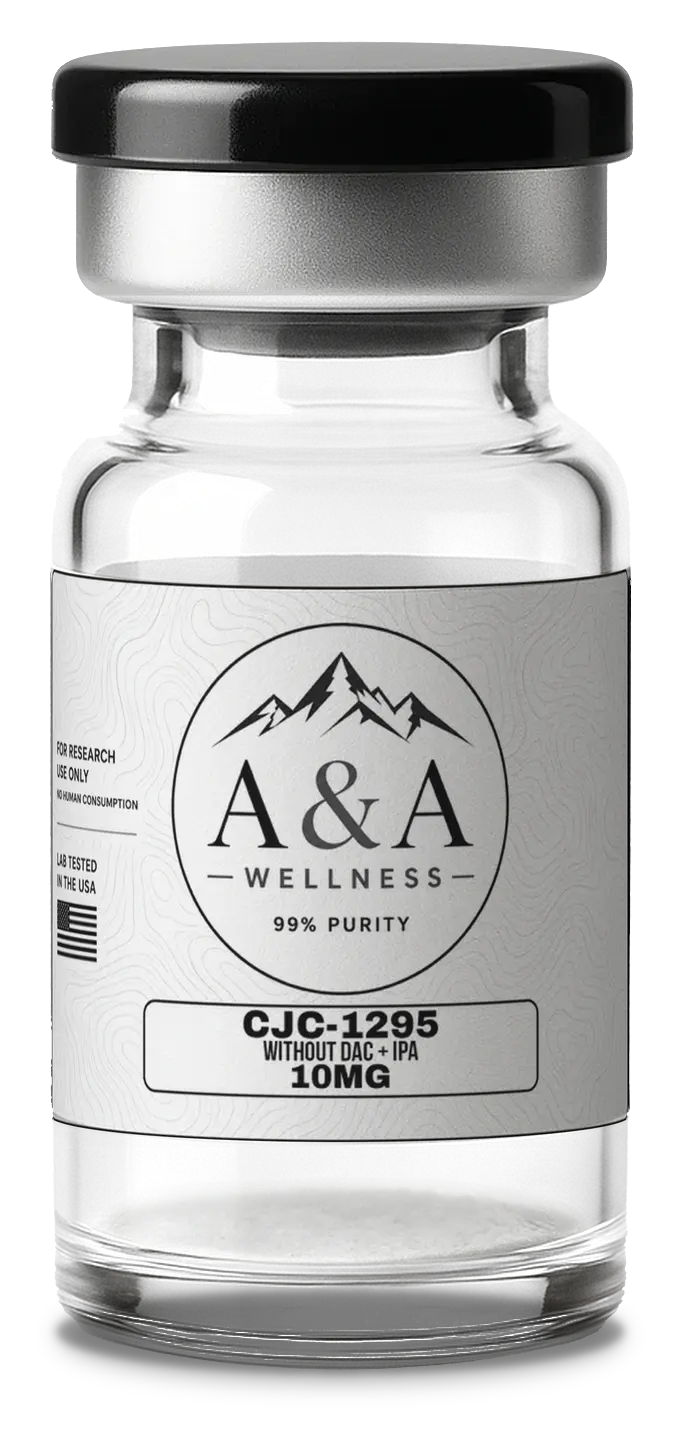
A&A Wellness supplies CJC-1295 Without DAC + Ipamorelin as a combined research material. It is for laboratory use only and is not a drug, food, cosmetic or supplement, nor for human or veterinary use.
Classification and structure
Built on GHRH(1-29)
Native human GHRH has 44 amino acids, but the N-terminal 1-29 fragment retains receptor activity. Sermorelin, a GHRH(1-29) peptide formerly marketed as a prescription product in the United States, was based on this fragment. The native fragment is cleared very quickly, largely because dipeptidyl peptidase-4 (DPP-4) cleaves it between positions 2 and 3.
Four substitutions
The discovery paper describes CJC-1295 as a tetrasubstituted form of hGRF(1-29) (Jetté et al., Endocrinology 2005). The four substitutions commonly reported for this backbone are D-alanine at position 2, glutamine at 8, alanine at 15 and leucine at 27. They are intended to resist enzymatic cleavage and improve stability. The peptide sold as “without DAC” has this modified 29-residue backbone.
The Drug Affinity Complex
In the DAC version, a lysine bearing a maleimidopropionamide group is added at the C-terminus. The maleimide reacts with the free thiol at cysteine-34 of serum albumin, forming a covalent bioconjugate after administration. The concept was to use albumin’s long circulating life to carry the peptide (Jetté et al., 2005).
Why it matters for the literature. Removing the DAC group removes the albumin-binding mechanism. Pharmacokinetic findings reported for CJC-1295 with DAC, especially its prolonged duration of action, should not be assumed to apply to the without-DAC peptide.
Mechanism as described in the literature
CJC-1295 in either form is a GHRH receptor agonist. It binds the GHRH receptor on pituitary somatotroph cells, raising intracellular cyclic AMP and stimulating the synthesis and release of the body’s own GH. GH in turn drives hepatic production of insulin-like growth factor-I (IGF-I).
Pulsatility. A central research question for any long-acting GHRH analog is whether continuous receptor stimulation flattens the normal pulsatile pattern of GH release. Ionescu and Frohman addressed this directly in 2006 (see below).
Contrast with other compounds. CJC-1295’s pathway differs from that of ghrelin-receptor agonists such as ipamorelin, and from direct IGF-I analogs such as IGF-1 LR3. It is closest in mechanism to tesamorelin, which is also a GHRH analog but uses the full 1-44 sequence. Our growth hormone secretagogues overview compares these pathways.
Research history and key published studies
Discovery in rats (2005)
Jetté and colleagues synthesized three maleimido derivatives of hGRF(1-29) and bioconjugated them to human serum albumin. They reported that the conjugates were more stable against DPP-4 in vitro and remained bioactive in a pituitary-cell GH-secretion assay. In rats given subcutaneous doses, the best compound, CJC-1295, produced a roughly four-fold greater GH area under the curve over two hours than unmodified hGRF(1-29). In pharmacokinetic follow-up, it was detected in plasma beyond 72 hours, and a Western blot showed CJC-1295 immunoreactivity on the serum albumin band. That result is direct evidence for the albumin-conjugation mechanism (Jetté et al., Endocrinology 2005).
First human pharmacology (2006)
Teichman and colleagues reported two randomized, placebo-controlled, double-blind, ascending-dose studies in healthy adults aged 21 to 61, published in the Journal of Clinical Endocrinology & Metabolism. The studies evaluated single and repeated administration across several dose levels. The authors reported sustained, dose-dependent increases in GH and IGF-I and an estimated half-life of roughly six to eight days. They also reported evidence of a cumulative effect after multiple administrations, and no serious adverse reactions in the settings studied (Teichman et al., JCEM 2006).
Pulsatility study (2006)
Later that year, Ionescu and Frohman reported overnight GH profiles in healthy men aged 20 to 40, with blood sampled every 20 minutes before and one week after administration of CJC-1295. They found that the frequency and magnitude of GH pulses were unchanged. Trough and mean GH secretion and IGF-I production increased while GH pulsatility was preserved. They interpreted the large rise in trough GH levels as an important contributor to the increase in IGF-I (Ionescu & Frohman, JCEM 2006).
What happened next
Published clinical development of CJC-1295 did not progress to a marketed product, and peer-reviewed human data remain limited to these early pharmacology studies. A 2018 review of GH secretagogues noted that few long-term, rigorously controlled studies exist for the class as a whole (Sigalos & Pastuszak, Sex Med Rev 2018).
No published human data for the without-DAC form. We are not aware of peer-reviewed controlled human studies specifically of CJC-1295 without DAC.
Common points of confusion
- “Mod GRF(1-29)” vs sermorelin. Both are 29-residue GHRH fragments. Sermorelin has the native 1-29 sequence. Modified GRF(1-29), or CJC-1295 without DAC, carries the four stabilizing substitutions. They are different molecules with different stability profiles.
- Half-life claims. The multi-day half-life reported by Teichman and colleagues describes the DAC form, whose persistence comes from covalent albumin binding. It should not be quoted for the without-DAC peptide.
- Combination materials. When CJC-1295 without DAC is supplied together with ipamorelin, each component’s identity should be confirmed separately in the batch documentation. A single purity figure for a blend does not describe each peptide individually.
Regulatory status
- Not an approved drug. CJC-1295, with or without DAC, is not FDA-approved for any use, and no approved medicine contains it.
- Compounding status keeps changing. FDA’s treatment of CJC-1295 as a bulk drug substance for pharmacy compounding has changed several times since 2023 and was under active review in 2026. Compounding decisions apply to licensed pharmacies. They do not make a substance an approved drug and do not affect research-grade material.
- Sport rules. GHRH analogs are included on the World Anti-Doping Agency’s prohibited list.
- Research material only. A&A Wellness’s CJC-1295 without DAC is sold only for laboratory research.
General background is in our research peptides regulatory overview. It is not legal advice.
Handling and storage in the lab
A&A’s material is a lyophilized combination of CJC-1295 without DAC and ipamorelin in one vial. Handling should suit the more sensitive component.
- Storage. Keep sealed vials cold, dry and dark. Freezer storage is common for long-term holding of lyophilized peptides.
- Opening. Let the vial reach room temperature while sealed before opening.
- Preparation. Use aseptic technique and an appropriate diluent (see bacteriostatic vs sterile water). Swirl gently, and label vials with the date, diluent and concentration.
- After reconstitution. Refrigerate solutions, protect them from light, and aliquot to minimize freeze-thaw cycles.
See our peptide storage guide and reconstituting peptides for laboratory use.
Research-use notice
All A&A Wellness products are for research use only. They are not for human or veterinary use and are not a drug, food, cosmetic or dietary supplement. This page summarizes published research on CJC-1295, most of which concerns the DAC form. It does not describe or support any personal use. Please review our Research Use Policy before ordering.
Related resources
- Product page: CJC-1295 Without DAC + Ipamorelin
- Related compounds: Ipamorelin, Tesamorelin, IGF-1 LR3
- Guide: Growth hormone secretagogues: research overview
- Category: Research Peptides
- Quality: Our quality standards
Sources
- Jetté L, et al. Human growth hormone-releasing factor (hGRF)1-29-albumin bioconjugates activate the GRF receptor on the anterior pituitary in rats: identification of CJC-1295 as a long-lasting GRF analog. Endocrinology. 2005;146(7):3052-3058.
- Teichman SL, et al. Prolonged stimulation of growth hormone (GH) and insulin-like growth factor I secretion by CJC-1295, a long-acting analog of GH-releasing hormone, in healthy adults. J Clin Endocrinol Metab. 2006;91(3):799-805.
- Ionescu M, Frohman LA. Pulsatile secretion of growth hormone (GH) persists during continuous stimulation by CJC-1295, a long-acting GH-releasing hormone analog. J Clin Endocrinol Metab. 2006;91(12):4792-4797.
- Sigalos JT, Pastuszak AW. The Safety and Efficacy of Growth Hormone Secretagogues. Sex Med Rev. 2018;6(1):45-53.