What tesamorelin is
Tesamorelin is a synthetic analog of growth hormone-releasing hormone (GHRH), the hypothalamic peptide that signals the anterior pituitary to release growth hormone. It was developed by the Canadian company Theratechnologies and appears in earlier literature under the code TH9507. Older papers sometimes use the term “growth hormone-releasing factor (GRF)” instead of GHRH.
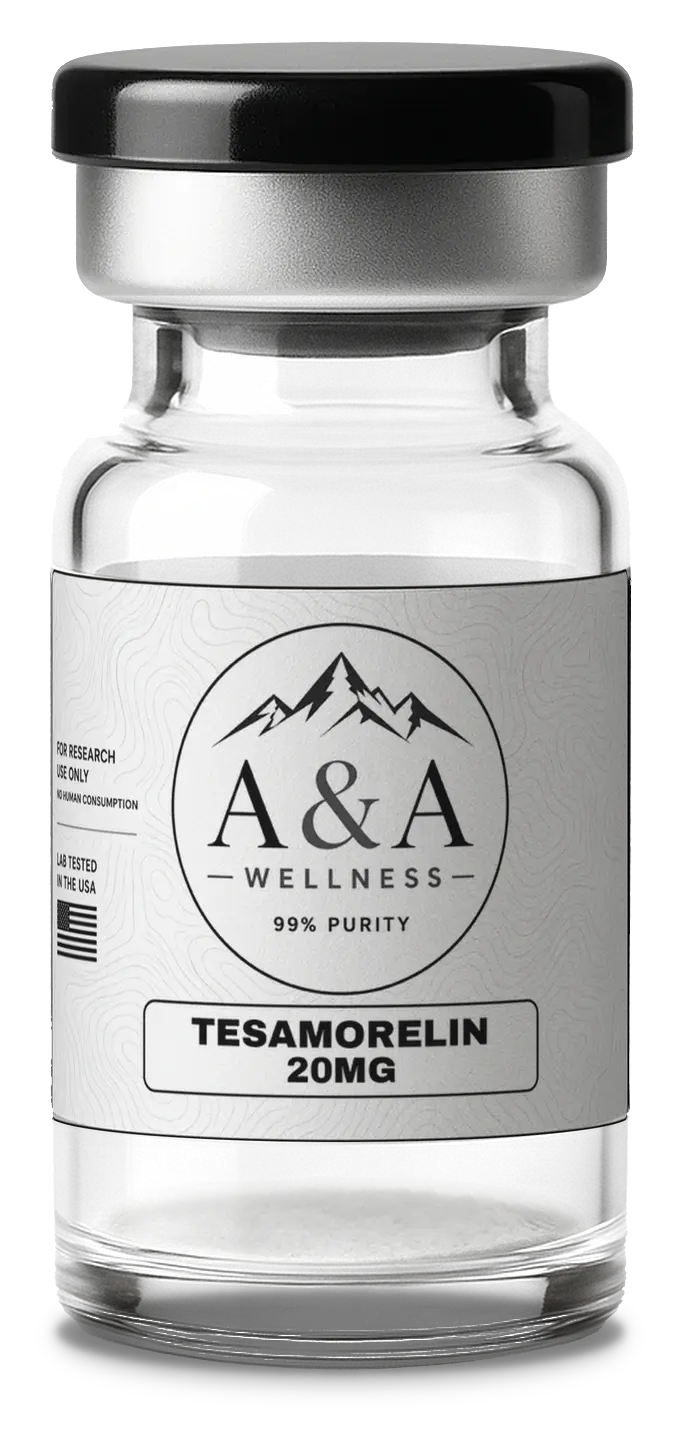
Approved-drug ingredient, research material: two different things. Tesamorelin is the active ingredient in prescription medicines approved by the U.S. Food and Drug Administration under the EGRIFTA brand. The material A&A Wellness supplies as Tesamorelin is a research-grade lyophilized peptide. It is not an EGRIFTA product, not a drug, and not for human or veterinary use.
This page describes tesamorelin’s classification, structure, the mechanism reported in the literature and its published clinical research. It includes no dosing or use guidance.
Classification and structure
A full-length GHRH analog
Native human GHRH is a 44-amino-acid peptide. Many research analogs, including CJC-1295, are built on the shorter GHRH(1-29) fragment, which retains receptor activity. Tesamorelin is different: it keeps the complete 1-44 sequence and adds one chemical modification.
The N-terminal hexenoyl modification
Tesamorelin carries a trans-3-hexenoyl group attached to the N-terminal tyrosine. Native GHRH is rapidly inactivated in circulation when the enzyme dipeptidyl peptidase-4 (DPP-4) cleaves its first two amino acids. Published descriptions of tesamorelin state that the N-terminal acylation increases resistance to this cleavage while keeping the peptide’s ability to bind and activate the GHRH receptor.
Salt form. Research and pharmaceutical tesamorelin is commonly supplied as an acetate salt. Specifications for a given batch should be taken from that batch’s documentation.
Mechanism as described in the literature
Tesamorelin acts at the GHRH receptor (GHRH-R), a class B G protein-coupled receptor found on somatotroph cells of the anterior pituitary. The reported sequence of events is:
- Receptor binding. Tesamorelin binds GHRH-R, which increases intracellular cyclic AMP in somatotrophs.
- Growth hormone release. The somatotrophs synthesize and release endogenous growth hormone (GH). Because the signal acts on the pituitary rather than replacing GH, release remains subject to the body’s normal feedback systems, including somatostatin inhibition.
- Downstream IGF-1. GH stimulates hepatic production of insulin-like growth factor-1 (IGF-1). Clinical studies of tesamorelin commonly measured IGF-1 as a pharmacodynamic marker.
This pituitary-mediated mechanism is the main conceptual difference between GHRH analogs and direct administration of recombinant GH or IGF-1 analogs such as IGF-1 LR3. It also separates GHRH analogs from ghrelin-receptor agonists such as ipamorelin, which reach GH release through a different receptor. Our growth hormone secretagogues overview maps these pathways.
Research history and key published studies
Most of the published human research on tesamorelin comes from one clinical setting: adults with HIV who developed excess visceral (abdominal) adipose tissue associated with antiretroviral therapy, a condition described as HIV-associated lipodystrophy.
First phase 3 trial (NEJM, 2007)
In December 2007, Falutz and colleagues published a randomized, double-blind, placebo-controlled phase 3 trial in the New England Journal of Medicine. It enrolled HIV-infected patients with abdominal fat accumulation. The investigators reported that tesamorelin given for 26 weeks decreased visceral adipose tissue and improved lipid profiles compared with placebo (Falutz et al., NEJM 2007).
Pooled phase 3 analysis (JCEM, 2010)
A 2010 pooled analysis in the Journal of Clinical Endocrinology & Metabolism combined two multicenter phase 3 trials with safety-extension data. The authors reported that reductions in visceral adipose tissue were maintained for up to 52 weeks and that subcutaneous abdominal fat was preserved. They also reported no clinically meaningful changes in glucose parameters over the study period (Falutz et al., JCEM 2010). Glucose and IGF-1 monitoring are recurring themes in this literature.
Inflammatory marker analysis (AIDS, 2011)
A secondary analysis of 410 trial participants, published in AIDS in 2011, measured circulating fibrinolytic and inflammatory markers (PAI-1, tPA, C-reactive protein and adiponectin). It related changes in those markers to changes in visceral adipose tissue. The authors described the observed marker effects as modest and said further studies were needed to determine their clinical significance (Stanley et al., AIDS 2011).
Liver fat studies (JAMA, 2014; Lancet HIV, 2019)
Researchers at Massachusetts General Hospital then looked at hepatic fat:
- JAMA, 2014. A double-blind, randomized, placebo-controlled trial in 50 antiretroviral-treated adults with HIV and abdominal fat accumulation measured both visceral fat and liver fat over six months (Stanley et al., JAMA 2014).
- Lancet HIV, 2019. A randomized, double-blind, multicentre trial in people with HIV and non-alcoholic fatty liver disease followed. The authors concluded that tesamorelin “might be beneficial” in this population and called for further studies of long-term effects on liver histology (Stanley et al., Lancet HIV 2019).
How the trials measured outcomes
Readers of this literature will see the same measurement methods again and again:
- Imaging for visceral fat. Visceral adipose tissue was usually quantified by computed tomography (CT) at a single lumbar level. This lets investigators separate visceral from subcutaneous abdominal fat.
- Spectroscopy for liver fat. The liver studies used proton magnetic resonance spectroscopy to measure the hepatic fat fraction.
- Safety laboratory panels. IGF-1 and glucose measures were tracked as safety and pharmacodynamic markers, since raising GH secretion can affect both.
Why methods matter. Knowing these methods helps when comparing tesamorelin papers with studies of other GHRH-pathway compounds. Differences in imaging technique, study population and trial duration limit how directly results can be compared.
A narrow evidence base. The controlled clinical evidence for tesamorelin is concentrated in HIV-associated populations. Findings from one population should not be assumed to generalize to others.
Regulatory status
- First approval (2010). The FDA approved tesamorelin, as EGRIFTA, in November 2010 to reduce excess abdominal fat in adults with HIV who have lipodystrophy.
- Reformulations. Later formulations were introduced, including EGRIFTA SV. In March 2025 the FDA approved a supplemental application for a new formulation marketed as EGRIFTA WR (Theratechnologies, March 2025).
- What the approval covers. These approvals apply to specific finished pharmaceutical products, manufactured and labelled under drug regulations, for one prescribed indication.
- A&A’s material is not EGRIFTA. A&A Wellness’s tesamorelin is a research material for laboratory use only. It is not an approved drug and not intended for human or veterinary use.
- Sport rules. GHRH and its analogs appear on the World Anti-Doping Agency’s prohibited list, which matters for anyone working in sport-science settings.
General regulatory background is in our research peptides regulatory overview. It is not legal advice.
Handling and storage in the lab
Tesamorelin is supplied as a lyophilized powder. As a 44-residue peptide, it is sensitive to moisture, heat and repeated freeze-thaw cycles, like other longer peptides.
- Storage. Keep sealed vials cold, dry and protected from light. Long-term storage at freezer temperatures is a common convention for lyophilized peptides.
- Condensation control. Allow a sealed vial to reach room temperature before opening.
- Aseptic preparation. Use sterile technique and an appropriate laboratory diluent. Swirl gently rather than shaking, and label every vial with the date, diluent and concentration.
- After reconstitution. Refrigerate solutions, protect them from light, and aliquot them to avoid repeated freeze-thaw cycles.
See our peptide storage guide and reconstitution guide for laboratory use.
Research-use notice
All A&A Wellness products are for research use only. They are not for human or veterinary use and are not a drug, food, cosmetic or dietary supplement. The clinical studies described above used pharmaceutical-grade tesamorelin under regulated trial conditions. Nothing on this page suggests or supports personal use. Please read our Research Use Policy before ordering.
Related resources
- Product page: Tesamorelin
- Related compounds: CJC-1295, Ipamorelin, IGF-1 LR3
- Guide: Growth hormone secretagogues: research overview
- Category: Research Peptides
- Quality: Our quality standards
Sources
- Falutz J, et al. Metabolic effects of a growth hormone-releasing factor in patients with HIV. N Engl J Med. 2007;357(23):2359-2370.
- Falutz J, et al. Effects of tesamorelin (TH9507), a growth hormone-releasing factor analog, in human immunodeficiency virus-infected patients with excess abdominal fat: a pooled analysis of two multicenter, double-blind placebo-controlled phase 3 trials with safety extension data. J Clin Endocrinol Metab. 2010;95(9):4291-4304.
- Stanley TL, et al. Effect of tesamorelin on visceral fat and liver fat in HIV-infected patients with abdominal fat accumulation: a randomized clinical trial. JAMA. 2014;312(4):380-389.
- Stanley TL, et al. Effects of tesamorelin on non-alcoholic fatty liver disease in HIV: a randomised, double-blind, multicentre trial. Lancet HIV. 2019;6(12):e821-e830.
- Stanley TL, et al. Effects of tesamorelin on inflammatory markers in HIV patients with excess abdominal fat: relationship with visceral adipose reduction. AIDS. 2011;25(10):1281-1288.
- Theratechnologies Inc. press release (March 2025): FDA approval of EGRIFTA WR (tesamorelin F8 formulation).